If you run Google AdSense on a WordPress site, there is an important change coming your way. Starting February 17, 2027, Google AdSense and Google Ad Manager will change how display ad impressions are counted. The current Count-on-Download method, usually abbreviated as COD, will be replaced by Begin-to-Render, or BTR.
You do not need to change your AdSense setup because of this update. However, your reports may look different, and publishers may see fewer reported display impressions after the transition. That makes it worth understanding what Google is changing and what it means for the way you manage advertising on your site.
The difference between the two methods comes down to when Google considers an ad impression to have happened.
With Count-on-Download, an impression is counted when the ad starts downloading to the user’s device. The ad does not necessarily have to reach the point where its creative starts rendering on the screen. If a visitor leaves the page during the loading process, that impression could still be included in the current reporting.
Begin-to-Render moves that point further along in the delivery process. Google counts the impression once the creative has successfully loaded and its rendering has started on the user’s device. This creates a stricter definition of an impression because the ad has progressed further toward actually being displayed to the visitor.
The change applies to display banner inventory on the web, mobile web, and CTV. Google already uses or supports BTR-compatible measurement for other inventory types, including native, app, and video advertising. The upcoming change therefore brings display banners more closely in line with the measurement approach already used for those formats.
The change is part of a broader effort to align impression measurement with industry standards and demand-side measurement. Google describes BTR as the industry standard and preferred methodology for impression counting. It also means Google counts an impression closer to when the ad actually starts rendering.
That distinction matters because an ad request alone does not tell you whether an ad ever made it onto the screen. A visitor may close a page, navigate somewhere else, or move through a page before the creative has finished loading. Under COD, some of these situations could still result in an impression being counted. Under BTR, they generally will not.
For publishers, this makes the reported impression number a little more meaningful. At the same time, it also means that the number in your AdSense or Ad Manager reports may become smaller.
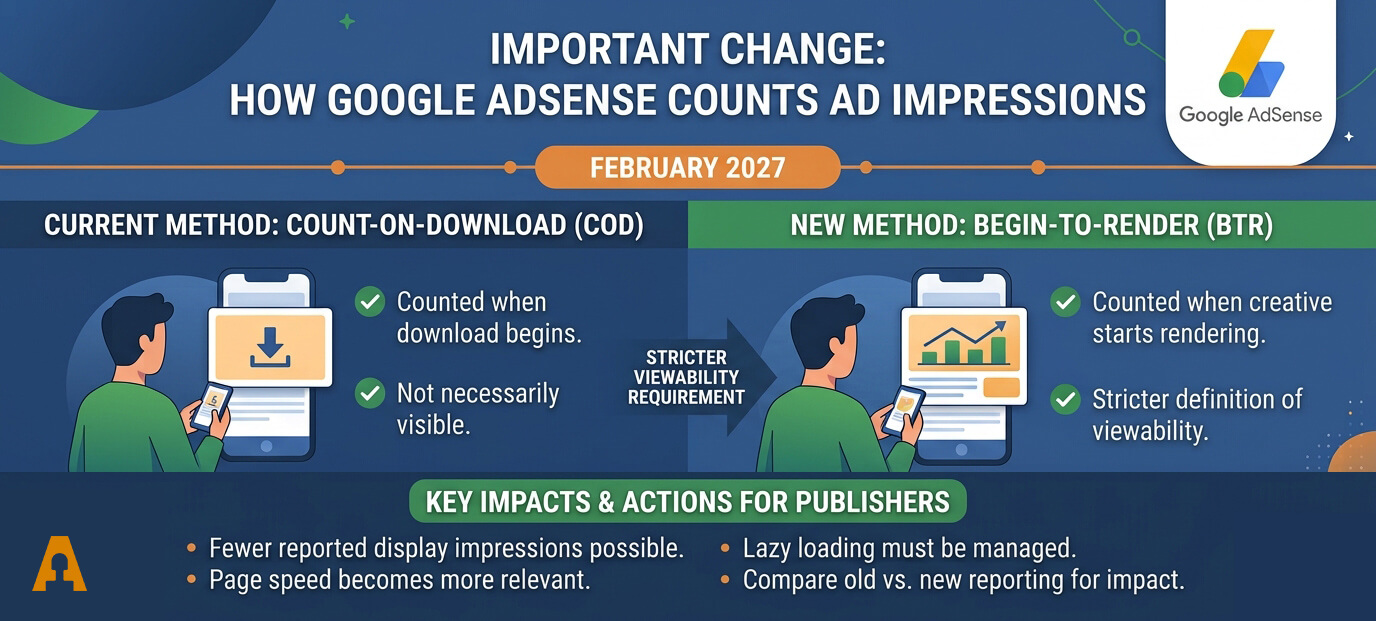
Yes, reported display impressions may decrease, and Google explicitly warns publishers about it. Because BTR counts impressions later in the ad-serving process, ads abandoned before rendering can drop out of the impression count.
The important point is that fewer impressions do not automatically mean that your website has lost the same proportion of advertising revenue. The new number is based on a different counting methodology, so comparing your post-change impression count directly with historical COD figures can be misleading.
There is also an important distinction between impressions and viewability. BTR increases the likelihood that a counted impression had an opportunity to be seen because the creative has started rendering. It does not mean that every BTR impression was actually viewed by the visitor, nor does Google say that the change will automatically increase publisher revenue or CPMs. Those outcomes depend on your inventory, demand, user behavior, and other factors.
The practical side of the change is particularly interesting for WordPress publishers.
BTR makes the rendering process more important because an impression is counted only once the creative has successfully loaded and rendering has begun. Anything that unnecessarily delays this process can therefore affect how many impressions ultimately qualify.
Google specifically points to the number of creative assets, synchronous scripts, and the number of partners involved in the supply chain as factors that can affect how quickly an ad reaches the rendering stage. More assets can mean longer download times, while synchronous scripts can serialize parts of the process. Additional partners can also add latency.
This does not mean that every publisher needs to rebuild their ad stack. Google currently says that no action is required for the transition itself. It does, however, make performance and ad delivery worth monitoring, particularly on sites where ads already load slowly.
Deferred loading is another area publishers should keep an eye on. Lazy rendering directly affects BTR measurement because it determines when the browser begins rendering the creative. Google notes that increasing the render margin or fetch margin can cause assets to load earlier. This can make an ad more likely to be ready when it enters the viewport, although earlier loading also increases network and device resource requirements.
No universal setting works for every website. A news site with long articles and frequent scrolling behaves differently from a smaller blog with short posts. The goal is to find a sensible balance between performance and ad readiness, rather than loading every ad as early as possible.
For WordPress publishers, this is where a proper ad management setup becomes useful. AdPresso can handle lazy loading as part of the placement configuration, allowing publishers to manage ad delivery without adding individual implementation logic throughout their content.
Google provides a practical way for Ad Manager publishers to estimate the potential difference before the switch.
You can compare your existing Ad Server impressions with Begin-to-Render impressions in Ad Manager reporting. Google recommends creating a historical report with a start date after August 12, 2026, and comparing the relevant metrics across dimensions such as demand channel, inventory format, inventory type, and device category.
This gives you something much more useful than simply guessing how many impressions you might lose. You can identify where the largest differences occur and investigate whether certain devices, creatives, buyers, or placements are particularly affected. That kind of comparison can also reveal performance problems that were previously hidden by the broader COD definition.
There is no need to panic or make drastic changes simply because Google has announced the transition. Google explicitly states that no action is required for the switch itself. A more useful approach is to treat the coming months as an opportunity to understand how your current ad setup behaves.
Start by reviewing your ad-loading performance and identifying placements that consistently take a long time to render. Check whether lazy loading settings are delaying ads unnecessarily, particularly for placements users reach quickly. It is also worth reviewing how many third-party partners and scripts are involved in your delivery chain.
Most importantly, do not judge a placement purely by where it sits on the page. An ad above the fold may look valuable because it appears near the top of the page. If the creative loads slowly, however, a visitor may already have moved on before it starts rendering. A placement further down the article could potentially perform differently if visitors spend more time in that part of the page.
This is where actual measurement becomes more useful than assumptions about position.
AdPresso gives WordPress publishers a central way to manage placements, ad delivery, lazy loading, and related configuration instead of scattering advertising logic across individual posts or theme files. You can configure placements, lazy loading, and other layout settings directly from the AdPresso interface.
For publishers preparing for the Google AdSense BTR transition, the broader lesson is simple. Ad management should not stop at deciding where an ad appears. You also need to understand whether the ad gets the opportunity to render and how different placements perform in real-world use.
