WordPress ad management has been around almost as long as WordPress itself. Long before publishers had sophisticated ad servers, header bidding setups, or automated demand partners, they needed a simple way to put an ad into a post, rotate a few banners, or insert an AdSense block without editing theme files.
That need created a surprisingly large ecosystem of WordPress ad plugins. Some became established products. Others disappeared after a few years. A small group evolved with the market and is still around today.
The history of these plugins tells a useful story about WordPress publishing. It also explains why today’s ad managers look so different from the tools that started the category.
The first generation focused on one problem. Publishers needed to get advertising code into their WordPress sites without touching the theme. AdSense Deluxe was an early example. It appeared in 2005 and gave publishers a way to manage reusable ad blocks and control where they appeared. At a time when AdSense was becoming an important revenue source for independent websites, this solved a very practical problem.
Other plugins followed the same path. AdSense Manager evolved into Advertising Manager, while plugins such as WP125 focused on banner advertising. OIO Publisher, first conceived in 2007, went a step further by giving publishers tools to manage and sell advertising space directly.
The market was still relatively simple. A publisher might have AdSense in one position, an advertiser banner in another, and perhaps a few affiliate links inside the content. The main challenge was inserting and organizing the ads.
As WordPress publishing became more professional, publishers needed more control. Ad rotation, scheduling, targeting, placement rules, and campaign management became increasingly important. Plugins such as AdRotate and Ad Inserter grew around these requirements, while OIO Publisher addressed the direct advertising market.
This was the first major shift in the category. An ad plugin was no longer just a convenient way to insert HTML or JavaScript. It increasingly became a small advertising system inside WordPress. The technical requirements changed quickly. Responsive websites became standard. Caching became essential for performance. Publishers wanted to test different placements, target specific content and devices, and manage advertising without creating dozens of separate snippets.
Advanced Ads emerged to solve this exact problem. In 2012, Thomas Maier ran an ad-monetized publishing business and grew frustrated with the limitations of available WordPress plugins. Existing tools did not adequately support requirements such as responsive advertising, caching, and split testing. He therefore developed his own ad management code for his publishing operation.
In 2014, that internal solution became the public Advanced Ads plugin. The product was built around a publisher’s needs rather than a single advertising network. That distinction helped define the next generation of WordPress ad management.
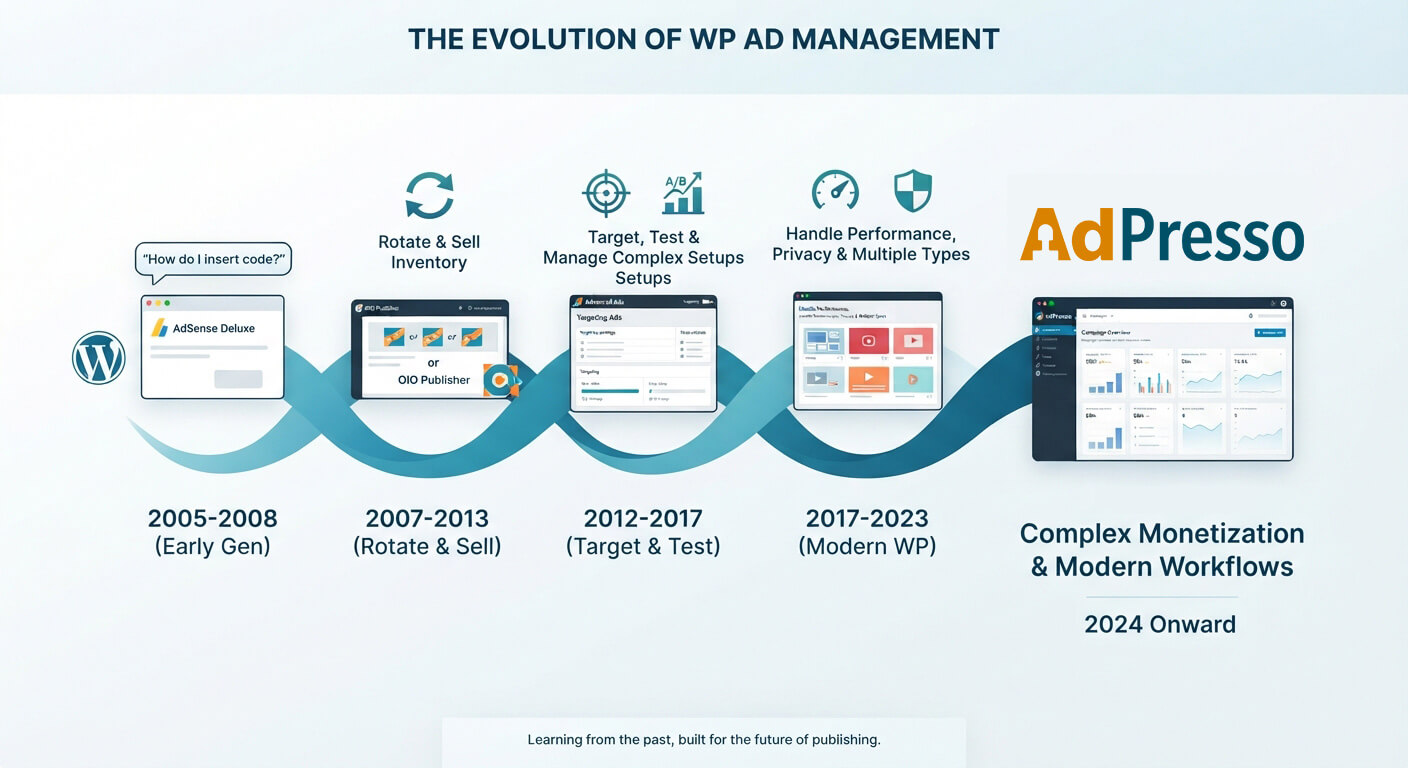
| Period | What publishers needed | Representative developments |
|---|---|---|
| 2005 to 2008 | Insert and reuse advertising code | AdSense Deluxe and similar tools |
| 2007 to 2013 | Rotate ads and sell inventory | OIO Publisher, AdRotate and banner managers |
| 2012 to 2017 | Target, test and manage more complex setups | Advanced Ads and other full ad managers |
| 2017 to 2023 | Handle performance, privacy, and multiple ad types | Advanced Ads, Ad Inserter, AdRotate and others |
| 2024 onward | Maintain complex monetization setups with modern WordPress requirements | AdPresso, Advanced Ads, Ad Inserter and others |
Google itself briefly became part of this plugin history. Google Publisher Plugin, later known as the AdSense plugin, offered WordPress publishers a direct way to connect their sites with Google’s advertising products. It became widely used, with contemporary reports putting it at more than 200,000 WordPress sites. Those historical figures are difficult to compare directly with today’s active installation statistics.
Google announced in March 2017 that it would retire the plugin. Google first stopped new signups, then restricted existing users, and ended support in May 2017. Google instead pointed publishers toward newer automated ad formats and other products. Later, the company focused on Site Kit.
The episode illustrated an important weakness of relying on a plugin tied closely to one platform. When the platform changes its product strategy, the plugin can become obsolete, no matter how many publishers use it.
The WordPress ad plugin market eventually developed a pattern that is still visible today. Building the first version of an ad manager is one problem. Maintaining it for ten or fifteen years is another.
WordPress changes continuously. PHP versions change. Browsers change. Advertising networks introduce new requirements. Privacy regulations add consent requirements. Google changes its advertising products. Publishers move from desktop to mobile and then toward increasingly performance-sensitive websites.
Every one of these changes creates development and support work. WPMU DEV provides a useful example. The company retired several legacy advertising plugins, including In Post Ads, Admin Ads, Ad Sharing, Ad Widget, and Simple Ads. Its explanation was straightforward. Maintaining older products required development and support resources that no longer matched their usage. The retired plugins were subsequently made available through GitHub.
Premium marketplace plugins faced a similar problem. Products could lose their developers, disappear from marketplaces, or stop receiving meaningful updates. WP Pro Advertising System, for example, is no longer available on CodeCanyon.
That is why the history of WordPress ad managers isn’t simply a story of successful plugins replacing unsuccessful ones, but also a story about maintenance economics.
Advanced Ads survived this transition and became an established name in WordPress advertising. The plugin expanded from basic ad insertion into targeting, scheduling, placements, tracking, Google Ad Manager integration, sticky ads, selling ads, and other publisher workflows. In 2023, Thomas Maier sold the Advanced Ads business to MonetizeMore. At the time, the existing team stayed on, and MonetizeMore announced further investment in the product.
The transition initially continued the product’s development. Advanced Ads 2.0 followed in 2025 after extensive work on the codebase and user interface. But 2025 also marked a major turning point for the product. Members of the long-standing Advanced Ads team moved on after years of developing and supporting the plugin. The Advanced Ads plugin didn’t disappear. It continues to receive updates under MonetizeMore. But the original product team that shaped it over many years was no longer behind its future direction.
This is where the story takes an unusual turn. In many software categories, when an established product team leaves, experienced developers move on to other companies or projects. In WordPress ad management, the former Advanced Ads team instead started again.
In 2026, the team behind AdPresso introduced a new WordPress ad manager based on years of experience developing and using Advanced Ads. That makes AdPresso different from another new plugin entering an established market. The team approaches the category with knowledge of the problems previous generations of WordPress ad managers had to solve, as well as the issues that became apparent after years of maintaining them.
The product also reflects how the requirements have changed. AdPresso is designed around a structured WordPress interface and publisher workflows. Its feature set covers conventional ad management as well as affiliate advertising, targeting, and ad tracking.
One particularly relevant example is Active View Tracking. AdPresso brings viewability measurement directly into the WordPress environment instead of treating it as something publishers have to investigate in a separate advertising platform.

The history doesn’t end with the disappearance of older plugins. Some early products are gone. Others have been abandoned or retired. Some established plugins are still maintained, including Ad Inserter and AdRotate. Ad Inserter currently has more than 300,000 active installations on WordPress.org, while AdRotate continues to receive updates.
Quads Ads Manager, another long-running product, even illustrates how complicated the category has become. WordPress.org temporarily removed it in late 2025 and reinstated it in 2026.
What has changed is what publishers need. The early plugins solved ad insertion. The next generation solved ad management. Today’s tools must handle performance, privacy like TCF, targeting, viewability, multiple advertising models, and increasingly complex publisher workflows.
AdPresso enters that market after the category has already gone through several cycles of expansion and consolidation. Its connection to the original Advanced Ads team gives the project a direct link to that history. For WordPress publishers, that is perhaps the most interesting part of the story. The old generation of ad plugins has not simply been replaced by something unrelated. Part of its experience has moved into a new product and a new chapter of WordPress ad management.