Header bidding has changed how publishers sell programmatic advertising. It is a technique that allows publishers to invite multiple buyers to compete for the same impression at roughly the same time, instead of offering it to one demand source after another.
That sounds like a relatively small technical change. It is not. Header bidding shifted more control over the auction back toward publishers and made it possible to compare demand sources on a much more level playing field.
The name can also be misleading. Modern header bidding is no longer simply a piece of JavaScript placed in the HTML <head>. Depending on the setup, an auction can involve browser-based bidding, server-to-server requests, hybrid wrappers, SSPs, ad networks, consent management, identity solutions, price floors, and the publisher’s ad server.
For publishers, the important question is therefore not simply whether header bidding can increase revenue. The better question is how to build an auction that creates meaningful competition without slowing down the site or creating an operational headache.
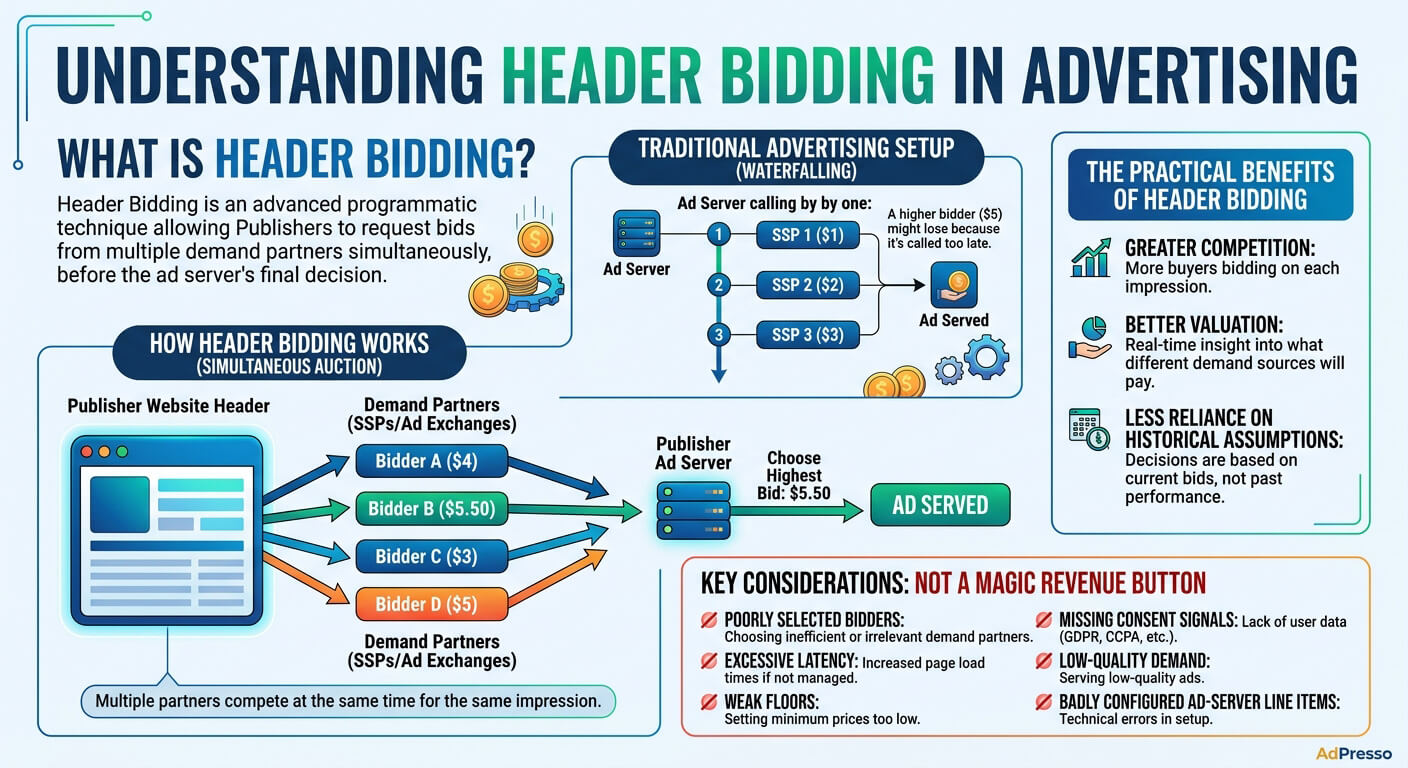
Header bidding is an advanced programmatic advertising technique that allows publishers to request bids for their ad space from several demand partners before the publisher’s ad server makes its final decision about which ad to serve.
In a traditional setup, the ad server might call one demand source, then another, then another. The order is usually based on historical performance or predefined price levels. A buyer that would have paid more can therefore lose an impression simply because it was called too late.
Header bidding changes that logic. Multiple demand partners can compete for the same impression, and their bids are then passed into the publisher’s ad server for the final decision.
The practical benefit is greater competition for each impression. A publisher gets a better view of what different demand sources are willing to pay instead of relying heavily on historical assumptions about which partner should get access first.
That does not mean header bidding automatically produces higher revenue. Poorly selected bidders, excessive latency, weak floors, missing consent signals, low-quality demand, or badly configured ad-server line items can undermine the entire setup. Header bidding is therefore best understood as an auction architecture, not as a magic revenue button.
There are two major ways to run the auction.
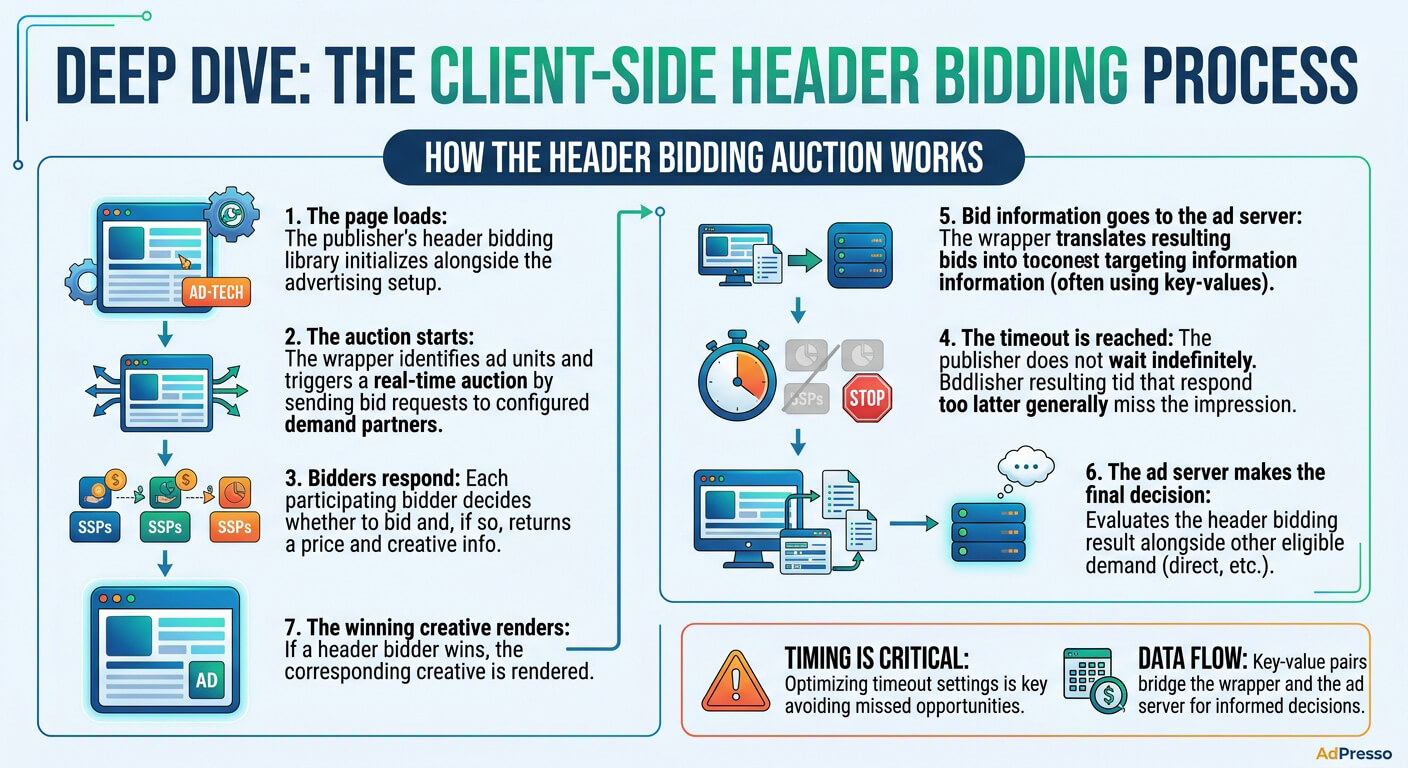
With client-side header bidding, the auction takes place directly in the visitor’s browser as it communicates with the participating bidders. A wrapper such as Prebid.js coordinates the auction, waits for responses until a defined timeout, and sends the resulting bid information to the ad server.
With server-side header bidding, the browser sends a request to a header bidding server. That server communicates with several bidders and returns the results to the browser. This reduces the number of connections and processing tasks performed by the user’s device.
The trade-off matters. Client-side bidding can give bidders better access to browser-level signals and may provide stronger user matching for some demand sources. Server-side bidding can reduce browser workload and make it easier to connect more bidders without creating a corresponding number of browser requests.
Many mature setups therefore use both approaches.
Before header bidding became widespread, publishers commonly used the waterfall method. The basic idea was straightforward. A publisher ranked demand sources according to expected yield. If the first partner didn’t fill the impression or didn’t meet the required price, the request moved to the next partner.
The problem is that historical performance doesn’t reflect an individual impression’s value.
Imagine that Network A historically generates a $2 CPM while Network B generates $3.50. If Network A is placed first, Network B might never get the opportunity to bid on impressions that it would have valued at considerably more.
The waterfall therefore introduced a structural inefficiency. The publisher decided who got access to the impression before seeing the full set of available bids.
It also created a lot of maintenance work. Publishers had to manage price levels, partner priorities, and historical performance data, then adjust the setup as demand changed.
Header bidding attacked the problem at its source. Instead of asking which partner to call first, the publisher could compare real-time offers and award the impression to the highest bidder.
Header bidding did not make the publisher’s ad server obsolete. Google Ad Manager and other major ad servers already had mechanisms for comparing different forms of demand, such as Google AdX via Dynamic Allocation or Open Bidding, which allowed eligible programmatic demand to compete with other inventory within the ad server environment.
Google’s First Look extended this principle by allowing eligible high-value bids to compete against certain reservation inventory, subject to the relevant pricing and targeting rules.
Header bidding added another source of competition before the ad server made its final decision.
The important distinction is that the header bidding wrapper conducts the auction among its configured demand partners, while the ad server still decides which eligible demand ultimately gets the impression.
This relationship matters when implementing header bidding. A publisher can have excellent bidders and strong CPMs, but if the ad-server setup does not allow those bids to compete properly, the revenue opportunity is lost.
The first generation of header bidding was predominantly client-side. A JavaScript wrapper ran in the browser and contacted each configured bidder directly.
That approach works, but every additional bidder can mean another network request, another response to process, and another potential source of latency.
Server-to-server bidding moves part of this workload away from the browser. A publisher can make one request to a header bidding server, which then communicates with several demand partners. This makes it easier to scale the number of demand sources without putting every connection on the user’s device.
There is a trade-off. Server-side bidders may have less access to browser-level information than a bidder called directly from the page. User matching can therefore be weaker for some partners. This is why hybrid header bidding is often useful. High-value or particularly effective bidders can remain client-side, while additional demand sources are routed through the server.
This is where getting started can become confusing. A publisher will encounter SSPs, exchanges, ad networks, direct bidding platforms, and managed header bidding providers. They do not all offer the same type of demand or require the same technical setup.
An SSP (Supply-Side Platform) connects publisher inventory with programmatic buyers, often linking to a broader ad exchange. It provides the technology for auctions, inventory management, and other parts of the selling process.
An ad network generally aggregates advertiser demand and makes it available to publishers. The boundaries between SSPs and ad networks have blurred because many companies now offer overlapping services.
For a publisher starting out, the label matters less than the real question: Does this partner bring additional demand that is relevant to my audience and inventory?
The following companies are reasonable starting points for publishers researching direct demand integrations. They are not a ranking, and a publisher does not need all of them.
Magnite is a large independent sell-side platform with publisher monetization technology and support for Prebid-based setups. It is more relevant to established publishers than to very small sites.
PubMatic provides publisher-side programmatic infrastructure and supports standard header bidding integrations. Its current supply policy also gives publishers a useful indication of what a major SSP expects from participating sites.
Index Exchange is another established SSP with both client-side and server-side Prebid integrations. Its current documentation explicitly supports publishers using Prebid Server to retrieve Index demand alongside other SSPs and exchanges.
OpenX provides publisher monetization across display, mobile, video, and native and supports header bidding integrations. Its current supply policy is particularly useful for publishers because it spells out requirements around original content, user engagement, site ownership, and traffic quality.
Amazon Publisher Services, or APS, provides another source of programmatic demand. Amazon also introduced an APS Prebid Adapter in open beta in January 2026, allowing publishers with existing Prebid setups to connect them to APS.
Criteo can be particularly interesting for publishers with commerce-related audiences and inventory. Criteo currently offers publisher integrations through existing header bidding wrappers and direct connections.
TripleLift is worth investigating for publishers with native, in-feed, and other formats where its demand is particularly relevant.
Regional SSPs and demand partners also matter. For a publisher with most of its traffic in Germany, France, Poland, or another specific market, a regional partner can sometimes be more useful than another global bidder.
No single traffic number automatically makes a website suitable for header bidding. Demand partners assess publishers differently, and some are considerably more selective than others.
However, practical characteristics make a website more likely to be a useful programmatic property.
| Site characteristic | What you should have |
|---|---|
| Content | Original, substantial content that provides genuine value |
| Traffic | A consistent stream of real human visitors |
| Traffic sources | Clearly identifiable and legitimate sources |
| Geography | Enough traffic from markets where advertisers actively buy |
| Audience | A reasonably clear audience or topic |
| Ad inventory | Standard display placements that can generate meaningful impressions |
| Site ownership | Clear ownership or authorization to monetize the site |
| Domain | A developed website rather than a parked or unfinished domain |
| Privacy | Privacy policy and appropriate consent mechanisms |
| ads.txt | Ability to publish and maintain an ads.txt file |
| Brand safety | Content that can be accepted by mainstream advertising demand |
| Technical access | Ability to add ad code or integrate a header bidding solution |
| Measurement | Access to analytics so traffic, impressions, and performance can be monitored |
These are not universal acceptance rules. They are a practical checklist for deciding whether it is worth approaching demand partners.
Major SSPs increasingly care about content quality and traffic quality. PubMatic, for example, states that publisher properties should have original, valuable content, clear ownership, and real user engagement. OpenX similarly requires substantive original content and signs of user engagement.
You do not need a complicated sales deck to start contacting demand partners for real-time bidding. You do need basic information about your website.
Put these numbers together before submitting applications:
| Information | Example |
|---|---|
| Domain | example.com |
| Monthly page views | 800,000 |
| Monthly ad impressions | 1.2 million |
| Main countries | Germany 55%, Austria 15%, Switzerland 10% |
| Main devices | Mobile 68%, desktop 32% |
| Content type | Editorial, travel, technology, finance |
| Main ad formats | 300×250, 728×90, 320×100 |
| Traffic sources | Google, direct, social, newsletter |
| Current monetization | Google Ad Manager, AdSense, direct sales |
| ads.txt | Published and maintained |
| CMP | Name of your consent management platform |
| Contact | Publisher or company contact details |
You may not have every number in exactly this format. That is fine. The goal is to give a prospective partner enough information to understand your inventory.
Do not inflate your figures. Demand partners run their own traffic and quality checks, and inconsistencies can make an application harder, not easier. PubMatic, for example, describes reviewing publisher geography, audience reach, traffic sources, years in business, content quality, and the domains being monetized before approving inventory.
A smaller WordPress publisher shouldn’t start by trying to integrate ten SSPs.
Start with your existing advertising setup. If you already use Google Ad Manager, understand how your current inventory is structured and make sure you have standard ad units and reliable impression data.
Then approach two or three demand partners whose requirements appear realistic for your site. For a European publisher, a reasonable first research group could be PubMatic, Index Exchange, and OpenX. Depending on the site’s topic and audience, Criteo or Amazon Publisher Services may be worth adding to the evaluation.
When you contact them, explain that you want to integrate their demand using an advanced bidding setup based on Prebid, and provide your domain, traffic volume, main GEOs, content category, and existing ad stack.
Do not be surprised if a large SSP declines the application. That does not mean your website is unsuitable for programmatic advertising. It may simply mean your current traffic profile isn’t commercially attractive enough for that particular partner.
A typical client-side bidding process follows a fairly predictable sequence.
The auction therefore has several distinct components. The bidder provides the demand, the wrapper coordinates the auction, and the ad server makes the final delivery decision.
Header bidding is often described as a technical feature, but somebody has to operate it.
The ad server needs line items that correspond to the bid values coming from the header bidding wrapper. Publishers commonly create price buckets or price ranges so bids can be represented as targeting values. The ad server can then compare these values against other eligible demand.
Key-value targeting, line-item priorities, pricing, creatives, and delivery settings must work together.
Ad Operations handles much of the daily work. That includes trafficking, testing, monitoring line items, checking creatives, investigating discrepancies, updating configurations, and identifying bidders that stop responding or contribute little value.
Engineering is responsible for the technical infrastructure. That can include Prebid.js, server-side bidding, consent integrations, deployment processes, and page performance.
For larger publishers, treat header bidding like production software, not a script you add once and forget.
Revenue teams compare bidder performance, analyze floors, examine win rates, monitor CPMs and revenue, and decide whether a demand partner deserves more or less access to the inventory. The highest bid is not necessarily the most valuable bidder. A partner with slightly higher CPMs but poor fill and high latency may contribute less net revenue than a more reliable bidder.
Building a header bidding stack yourself gives you maximum control.
You choose the wrapper, demand partners, auction rules, server infrastructure, analytics, and deployment process. You avoid managed-service revenue share, and your team keeps direct access to the configuration.
The cost is expertise. You need people who understand ad servers, Prebid, JavaScript, privacy signals, bidder adapters, troubleshooting, and yield optimization. You also need somebody to maintain the system.
Managed header bidding providers take a different approach. They can provide the wrapper, demand relationships, infrastructure, and ongoing optimization. This reduces the technical work required from the publisher, but it comes with less control and potentially additional fees or revenue sharing.
| Publisher situation | Practical starting point |
|---|---|
| Small site with little technical capacity | Managed solution or simple demand setup |
| Growing site with some technical knowledge | Prebid-based setup with a limited number of bidders |
| Established publisher with Ad Ops | In-house Prebid or hybrid setup |
| Large publisher with engineering and yield teams | Custom client-side, server-side or hybrid architecture |
The relevant comparison is net revenue after technology costs, staff time, demand fees, and performance impact.
Header bidding has one obvious enemy: time. Every auction has to finish before the ad server can make its decision. If the page waits too long, users feel it. Slow auctions can delay ad rendering, worsen user experience, and reduce viewability. Too many client-side third-party bidders also create additional network activity.
A sensible timeout is the first line of defense. The timeout should give valuable bidders enough time to respond without allowing slow partners to hold up the ad call. Asynchronous loading is equally important because advertising code should not unnecessarily block the rest of the page.
Server-side bidding can reduce the number of direct browser connections. It can therefore be useful when a publisher wants to expand demand without adding another large group of client-side requests. The right configuration is a measurement problem. If a bidder contributes little revenue but regularly consumes a significant portion of the auction timeout, you should question its place in the setup.
Prebid is an open source framework that has become one of the most essential tools in programmatic advertising. By standardizing the wrapper layer, Prebid helps publishers connect with dozens of demand partners seamlessly without lock-in.
Prebid.js is the browser-based component. It provides the auction framework, bidder adapters, modules, analytics integrations, and mechanisms for passing bids to the ad server.
Prebid Server moves part of the auction to the server side. It can communicate with server-side bidder adapters, process their responses, and return the results to Prebid.js.
Prebid’s flexibility is particularly useful for publishers that want to mix client-side and server-side demand. A publisher can keep selected bidders in the browser while routing others through Prebid Server.
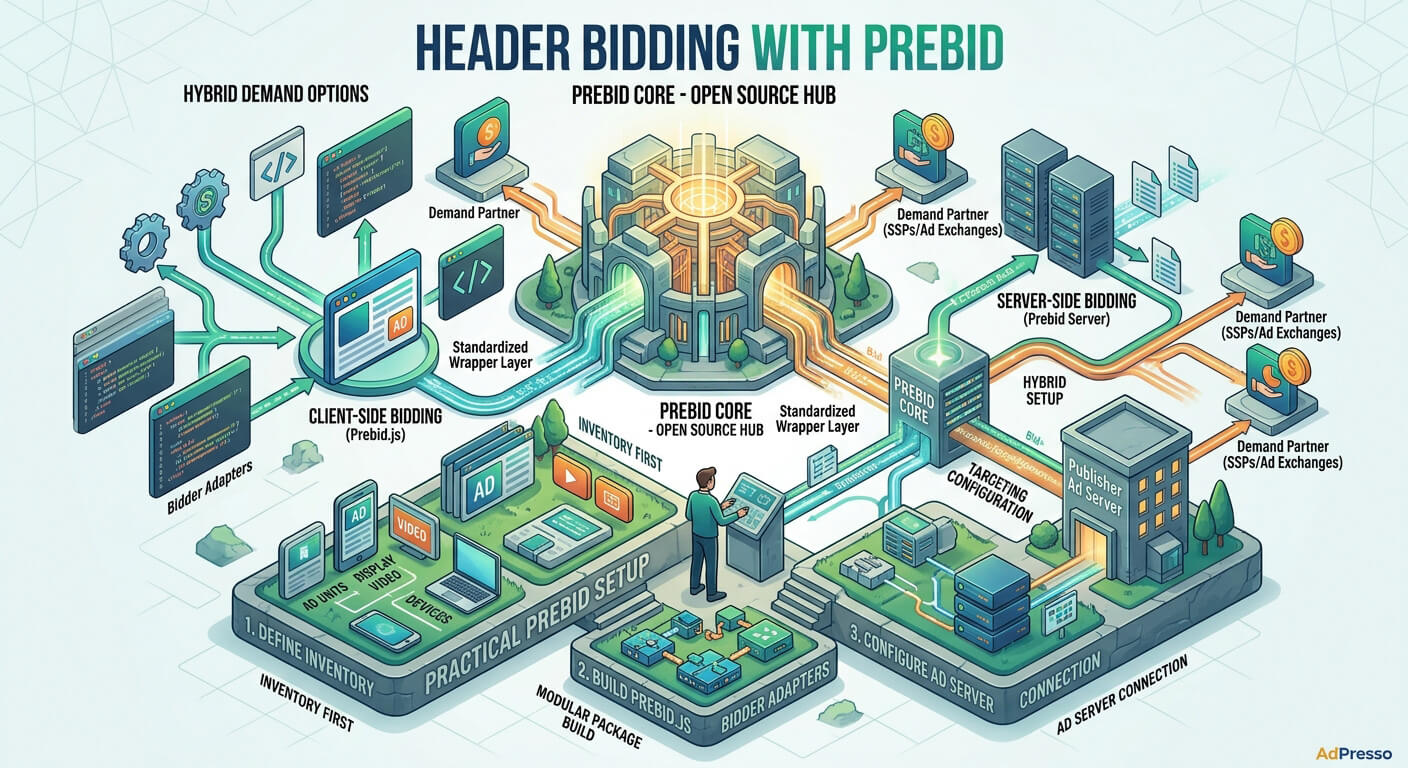
Start with the inventory, not the bidders. Define which ad units you want to monetize, which formats they support, and which devices they appear on. Then select a small number of demand partners that are relevant to your audience.
Build a Prebid.js package containing the adapters and modules you actually need. Configure the ad units and bidder parameters, then connect the resulting bids to the ad server.
The ad server needs corresponding line items and targeting configuration. Without this connection, Prebid can produce valid bids that never have a meaningful chance to win.
Do not move a complex Prebid setup directly into production. Start with a staging environment. Check that bidders respond, expected key-values reach the ad server, creatives render correctly, and timeouts behave as intended.
Once the setup is live, monitor it continuously.
| Metric | What it tells you |
|---|---|
| Bid rate | How often a bidder actually responds |
| Timeout rate | How often the bidder misses the auction window |
| Win rate | How often its bids win |
| CPM | What the demand is willing to pay |
| Revenue | The actual commercial contribution |
| Latency | How much time the bidder adds |
| Fill | How often available inventory receives a bid |
| Viewability | Whether the resulting ads are actually seen |
| Errors | Whether the integration is technically reliable |
Server-side implementations require another layer of monitoring. You need to know whether the request reaches Prebid Server, whether the relevant adapters respond, and whether the server-side auction completes before the client-side timeout.
Header bidding lets publishers create competition between multiple demand sources instead of relying on a predetermined waterfall. But the technology creates value only when the underlying inventory is attractive, and the auction is well managed.
For a publisher starting from scratch, the process can be much simpler than the ad tech terminology suggests.
First, check whether your site has original content, genuine traffic, a clear audience, and enough advertising inventory to justify additional demand. Then document your traffic by geography, device, and source.
Next, approach a small number of established demand partners rather than applying everywhere at once. Start with partners whose demand appears relevant to your audience and whose publisher requirements you can realistically meet.
Once you have demand relationships, build the auction with Prebid or a suitable managed solution. Keep the first implementation small. Measure the results. Only add another bidder when you have a reason to believe it can add incremental demand.
That last point is easy to overlook. A successful header bidding setup is not the one with the longest bidder list. It is the one where each additional demand source earns its place through revenue, demand quality, or useful competition without creating disproportionate technical cost.
For WordPress publishers in particular, using lightweight management tools like AdPresso simplifies the technical implementation of header bidding without overloading your site performance. You do not have to build an enterprise ad stack on day one. Start with solid inventory, a small number of relevant demand partners, and expand as your numbers grow.