For web publishers, driving more traffic is only half the battle. The real challenge is extracting maximum value from the visitors already landing on your site.
That is where yield optimization comes in. Rather than treating every ad impression as a uniform commodity, yield optimization analyzes your entire setup to locate revenue leaks, eliminate latency, and maximize inventory value.
Yield optimization touches placement strategy, viewability, fill rates, demand competition, dynamic pricing floors, page performance, and device-specific rendering. How ads are injected, loaded, rotated, and measured directly dictates whether inventory yields its full potential or gets wasted. The goal is to maximize total site revenue without destroying the user experience, rather than inflating the eCPM of a single isolated unit.
Yield optimization is the continuous process of maximizing revenue from a publisher’s available ad inventory. The focus lies on the term "available" because yield optimization converts existing pageviews into higher net revenue. It leverages real-time performance data to price, allocate, display, and monetize inventory across competing demand channels.
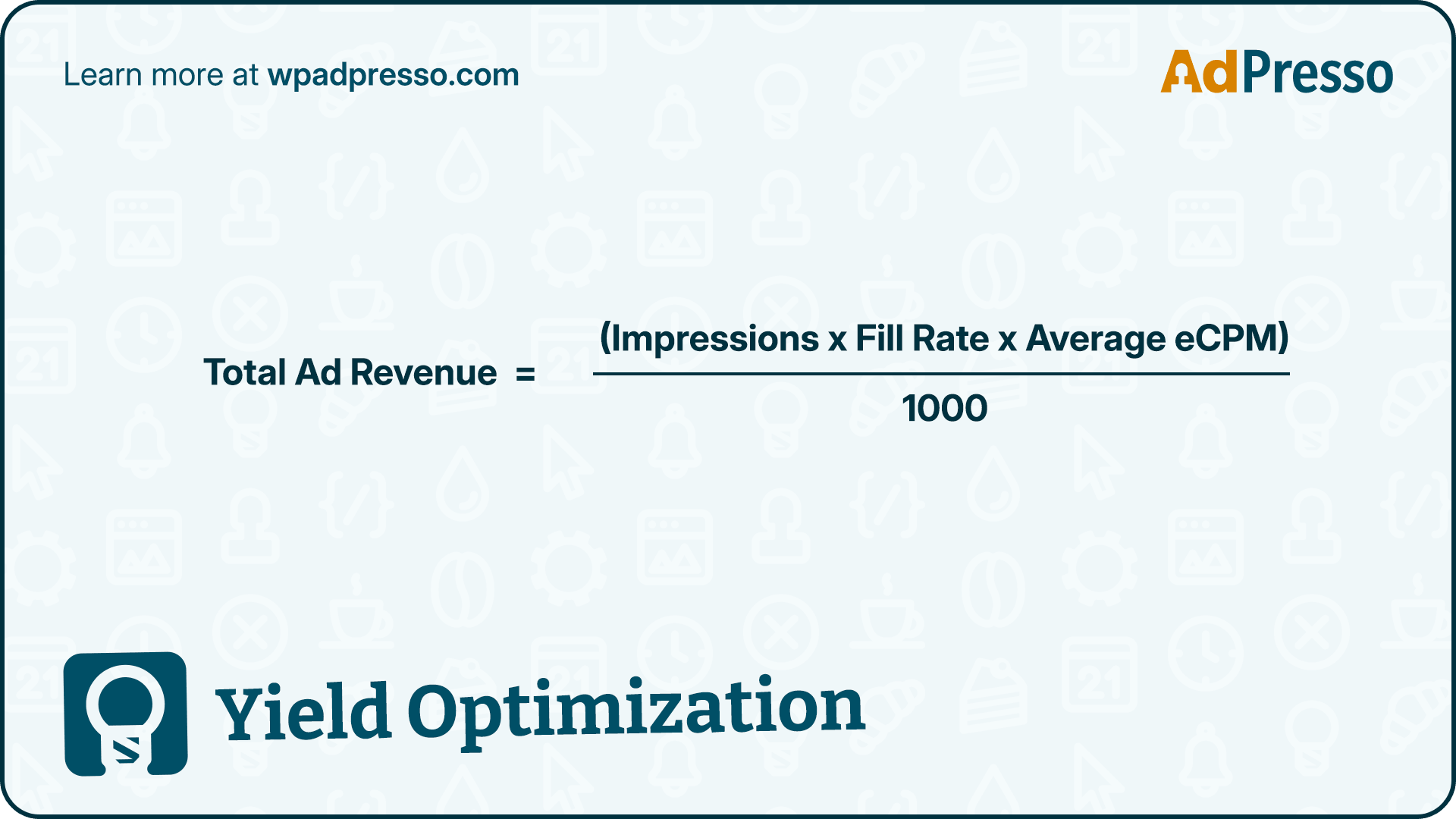
This equation highlights why optimizing single metrics in isolation backfires:
Publishers must find the sweet spot between these variables instead of treating them as independent silos.
The single metric that cuts through the yield optimization noise is Page RPM (Revenue Per Thousand Pageviews). It reflects the holistic yield of your entire page. As a rule of thumb, if a structural change increases your overall Page RPM without degrading site performance or user engagement, the optimization is a success, regardless of what individual eCPMs or fill rates suggest.
Dynamic pricing is a single tactical lever within yield optimization, not a substitute for it. Confusing the two leads publishers to focus entirely on auction mechanics while ignoring site-level structural flaws.
Dynamic pricing operates at the bid level, adjusting floor prices dynamically based on historical buyer behavior, geo-location, device, time of day, or predicted viewability.
In contrast, yield optimization takes command of the entire ecosystem, balancing yield metrics against site architecture, UX impact, and user retention.
Raising floor prices won’t fix an ad unit positioned where nobody scrolls, nor will it salvage ad revenue lost to a sluggish ad tag that tanks page speed.
| Dynamic Pricing | Yield Optimization | |
|---|---|---|
| Primary Focus | Adjusting impression floor prices | Maximizing total publisher revenue |
| Scope | Individual auction bids & price floors | Entire inventory, demand stack, layouts, performance & UX |
| Core Metrics | Bid rate, eCPM, Fill Rate | Page RPM, Total Revenue, Viewability, Core Web Vitals |
| Mechanism | Automated floor adjustments | Continuous structural, technical, and auction optimization |
| Objective | Prevent underselling high-value impressions | Build a scalable, high-yield monetization system |
A successful yield strategy targets five core structural pillars.
Monetization thrives on auction tension. Header bidding and unified auctions force multiple demand partners, e.g., SSPs, ad exchanges, and direct buyers, to compete simultaneously for the exact same impression in real time.
If your inventory is tied to a single primary network, you are accepting bid prices in a vacuum. Exposing every ad impression to maximum market competition ensures inventory trades at true market value.
Floor prices set the baseline bid required to win an ad slot. Setting floors too low lets premium buyers grab high-intent audiences cheaply. Setting them too high leaves inventory unsold, and craters fill rates.
Ditch static global floors. Effective floor price management uses dynamic adjustments tailored to audience geography, device capability, format type, and historic viewability.
You can have a theoretical $15 eCPM for an ad unit, but if users scroll past before it renders, that revenue disappears. Buyers bid aggressively on viewable impressions. Non-viewable inventory degrades domain reputation.
Above-the-fold (ATF) placements are not automatically superior. An ad placed mid-content or below the first paragraph often achieves higher viewability because users pause there to read.
Ad latency directly kills viewability and user retention. Heavy ad scripts, unoptimized creatives, and uncontrolled layout shifts frustrate visitors and lower search rankings. Lazy loading is essential. By delaying ad render requests until the slot is about to enter the viewport, you reduce initial DOM weight, improve Core Web Vitals, and ensure ad requests map directly to active user attention.
Treat performance as a core revenue driver. An extra ad slot that adds 2 seconds of page latency and increases bounce rates is losing you money overall.
Unfilled inventory is a total loss. When demand partners decline to bid or fail to hit your price floor, the ad slot should never render as blank space. Implement strict waterfall fallbacks. Unfilled programmatic slots should pass down to secondary demand networks, house promotions, high-margin affiliate offers, or direct-sold campaigns.
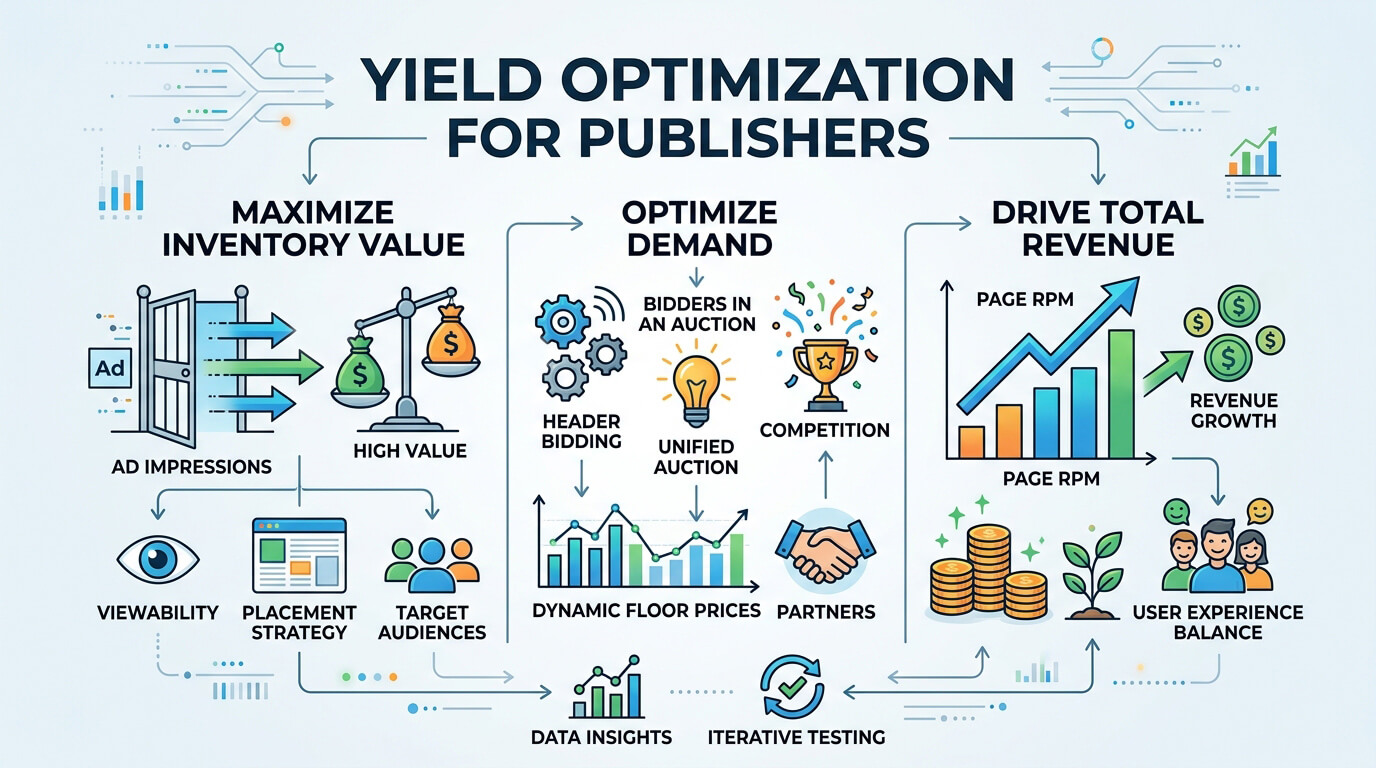
Yield optimization is often perceived as an exclusive game for enterprise publishers with complex header bidding wrappers and automated dynamic pricing engines. In reality, site-level yield optimization works with almost any demand source, from AdSense and affiliate networks to direct-sold campaigns.
Even without dynamic floor prices or real-time auction manipulation, WordPress publishers hold powerful levers to dramatically improve total yield simply by controlling how and where they serve their inventory.
A practical optimization process starts with an audit of your baseline performance across desktop and mobile. Look for obvious structural leaks such as low-viewability ad units below the fold, slow-loading third-party ad tags that delay content rendering, or unmonitored empty slots when a network fails to deliver.
Fixing these issues requires a shift away from hardcoded ad tags, scattered theme edits, or manual post modifications. Centralized management, such as that provided by AdPresso, allows publishers to systematically inject ads, apply dynamic insertion rules, or define explicit fallbacks for unfilled inventory.