Getting approved for Google AdSense nowadays can feel considerably harder than it did a few years ago. Google’s requirements may sound straightforward. Your website needs original content, a clear structure, a good user experience, and compliance with its publisher policies. In practice, however, approval depends on how all of these elements come together.
There is no magic formula for AdSense approval. You will find examples of well-established websites that were rejected for low-value content, just as you will find new websites that appear to have been approved with relatively little content or AI slop. These cases make it tempting to look for a shortcut.
That is rarely a good strategy.
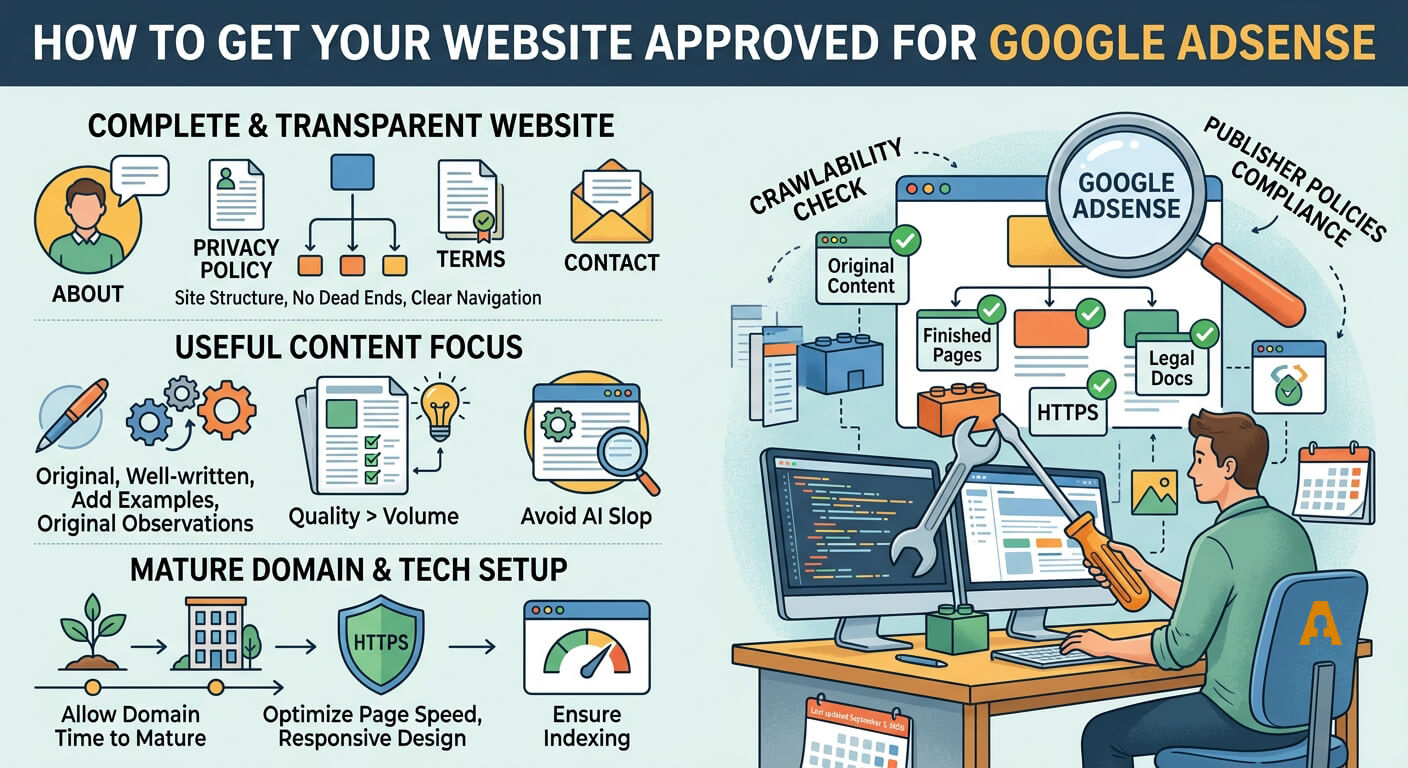
If you want to give your website the best possible chance of AdSense approval, focus on what you can actually control. Build a website that looks like a genuine publication, not a project created mainly to display ads. That means taking care of your content, site structure, technical setup, and transparency before you submit your application.
A useful way to approach the process is to look at three areas. Your website needs to be trustworthy and transparent, technically accessible, and valuable enough to give visitors a reason to stay.
Before Google reviews your website, make sure visitors can understand who is behind it and how the website works. Basic pages such as your privacy policy, terms and conditions, About page, and contact page are an important part of that picture.
Your privacy documentation should reflect the technologies and services actually used on your website. If you serve visitors in the European Union, you should also pay attention to applicable privacy and consent requirements.
Your About page can be surprisingly useful here. It gives visitors context about the people or organization behind the publication and explains what the site is actually about. A contact page adds another layer of transparency.
Your site structure matters just as much. Visitors should be able to move from one section to another without running into dead ends, empty categories, or pages that still look unfinished.
Before applying, check your website as if you were seeing it for the first time. Remove unused categories, fix broken links, complete unfinished pages, and make sure your main navigation leads somewhere useful.
A website does not need to look spectacular to pass an AdSense review. But it does need to look finished.

Content is where many AdSense applications run into trouble. This has become particularly relevant as AI tools have made it much easier to produce large quantities of articles. Using AI as part of your editorial workflow is not the same thing as publishing large amounts of generic, unedited content. The important question is whether the finished page offers genuine value to the reader.
A useful article should answer the search intent behind the query, provide enough context, and bring something to the table that is not simply a collection of information already repeated across dozens of other websites.
For a new publisher, I would rather see 15 to 20 well-developed articles than dozens of thin posts that exist mainly to increase the page count. The exact number is not an official AdSense requirement, but a substantial content base gives Google more of your site to evaluate.
Length alone does not make an article valuable either. A 2,000-word article can still be thin if it spends most of those words repeating the same points. What matters is the quality and usefulness of the information.
This is also where human editorial input makes a real difference. If you use AI to help with research or drafting, review the result carefully. Add examples, original observations, relevant data, useful comparisons, and a structure that actually fits the topic.
Think of these elements as experience signals. Screenshots, comparison tables, original images, practical examples, or first-hand observations can make an article considerably more useful than a generic text that could have been published on any website.
Google does not publish a universal minimum domain age for AdSense approval. Therefore, you should be careful with claims that a website must be 30 or 60 days old.
There is still a practical reason not to rush the application. A brand new domain with only a few freshly published pages gives Google very little to evaluate. Giving your website time to develop its content, structure, and organic visibility can therefore make more sense than submitting immediately.
The same applies to technical quality. Your website should work reliably on desktop and mobile devices, use HTTPS, and provide a straightforward browsing experience.
Page speed matters too, especially on mobile. Slow pages can affect the overall user experience, particularly when advertising scripts and other third-party resources are involved. Keeping the technical base clean before adding more monetization technology is a sensible starting point.
| Early AdSense Approval Era | AdSense Approval Today | |
|---|---|---|
| Domain age | New domains could be submitted with little history | No universal minimum is published, but an established site gives Google more to evaluate |
| Content volume | Relatively small sites could sometimes be approved | A substantial base of useful content makes the review easier to assess |
| Content quality | Thin or aggregated content was more common | Original, useful, and well-structured content matters much more |
| AI and automation | Not a major consideration | AI-assisted content needs meaningful editorial oversight and genuine value |
| Security | HTTP was once standard across the web | HTTPS is now standard practice for professional websites |
| Legal pages | Often less visible on small websites | Privacy, transparency, and publisher compliance are important |
| Review process | Often perceived as relatively quick | Review timing can vary depending on the site and application |
| Mobile experience | Much less important in the early web | Mobile usability is essential for modern publishers |
| AdSense setup | Relatively simple implementation | Verification, publisher setup, and technical integration all need attention |
Once your website is ready, you can submit it through your AdSense account. Google then verifies the website and evaluates whether it meets its requirements. Timing can vary, so it is best not to build your publishing schedule around a specific number of days.
The first part of the process involves technical checks. Google needs to access your website and crawl the relevant pages. Obvious technical problems, inaccessible pages, or policy violations can stop the process before a deeper evaluation.
Your site may then go through a broader assessment of its content, structure, and compliance. This is one reason preparation matters so much. A technically accessible website is not automatically a useful website, and a large collection of articles does not compensate for poor navigation or an unfinished appearance.
If your application is rejected, don’t assume adding more articles will solve the problem. Review the reason Google provides and the entire website. Low-value content can signal a broader issue with originality, usefulness, structure, or overall site quality.
At some point during the application process, Google requires you to add its verification code to your website. For WordPress publishers, this is one of those small technical steps that can become unnecessarily complicated when it involves manually editing theme files.
Changing a theme header directly is rarely the most convenient approach. Theme updates can overwrite changes, and a small code mistake can cause unexpected problems.
This is where an ad management plugin such as AdPresso can simplify the workflow. Instead of editing theme files, you can manage the AdSense verification code that belongs in the header with one click directly from your WordPress dashboard. That keeps the integration separate from your theme and makes future changes easier to manage.
The same principle becomes useful once your AdSense account is approved. Your website will gradually move from verification to actual ad management, and that is where a centralized setup becomes much more practical than scattered snippets across individual pages.
Getting approved is only the beginning of your advertising setup. If you work with AdSense and other advertising partners, you also need to keep your ads.txt file accurate.
The ads.txt file tells buyers which companies are authorized to sell advertising inventory for your domain. As your advertising setup grows, keeping these entries organized manually can become another small but annoying maintenance task.
A centralized WordPress workflow can help here, too. Instead of treating ads.txt as a completely separate technical task, you can manage the relevant advertising configuration alongside the rest of your monetization setup.
Before submitting your AdSense application, take a final tour through your website. You don’t need to hit an arbitrary number of pages or wait a specific number of days. You want the site to look complete, useful, and ready for real visitors.
Make sure that the following points are covered.
The most useful mindset shift is simple. Do not build your website around the question of what Google wants to approve. Build it around the question of why a visitor would want to use it.
That changes the way you approach almost everything. Instead of publishing another generic article because you need more content, you improve an existing page. Instead of creating ten empty categories, you create a structure that helps visitors find information. Instead of adding ads as quickly as possible, you make sure the website works well before monetization becomes the priority.
There is no guaranteed AdSense approval checklist. Google’s evaluation can change, and individual websites can produce very different results. What you can control is the quality of the publication you submit.
If your site has useful content, a clear structure, transparent information, solid technical foundations, and a sensible WordPress setup, you are giving Google a much stronger reason to approve it.
And once approval arrives, you are already starting from the right foundation for managing your advertising setup rather than having to rebuild the site around monetization afterward.
