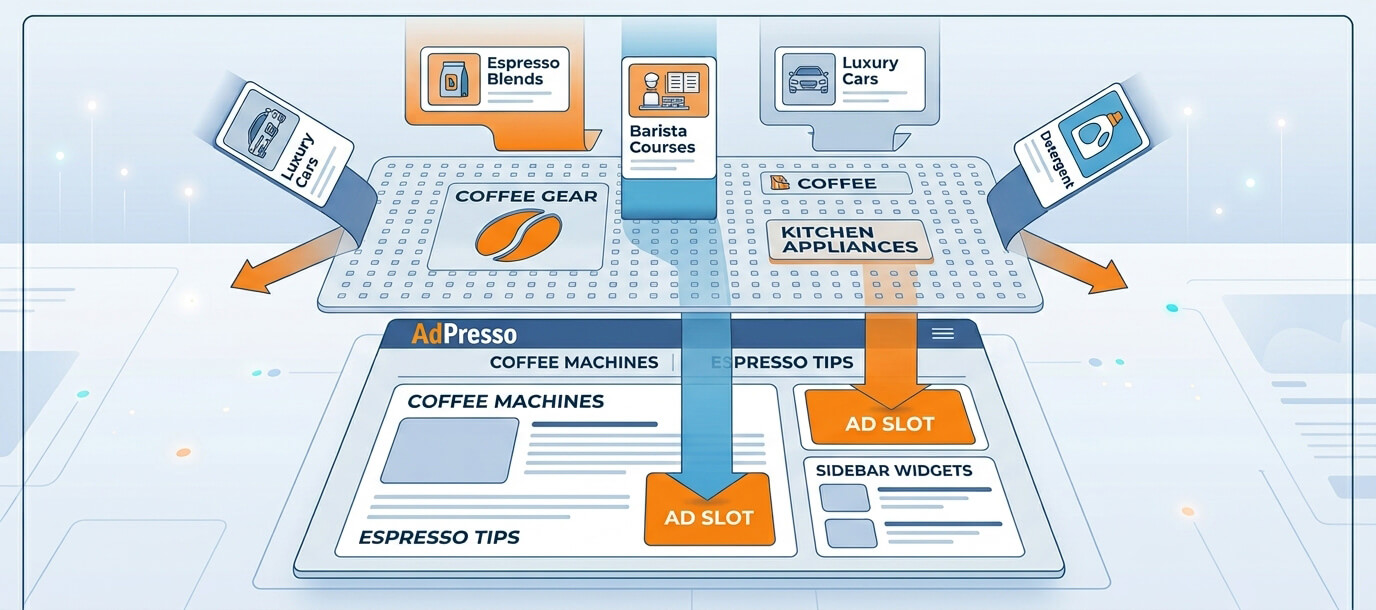
Contextual advertising in WordPress works particularly well when your website content gives you a clear signal about what a visitor is interested in. This makes it especially useful for affiliate marketing. An article about lever espresso machines can promote coffee equipment, a hiking guide can display outdoor products, and a running-shoe comparison can show relevant affiliate offers.
With WordPress and AdPresso, you can build these connections without creating a complex ad setup. The plugin provides you with several conditions that let you control which ads appear in which content.
The most important part is to decide what your content tells you about the right advertising environment. Once you have that classification, you can use AdPresso to route the right ads to the right pages.
Before creating an ad, review your content structure. What topics indicate that a visitor is likely to be interested in a particular product or service? For a niche publisher, these signals are often quite specific. A website about coffee might have articles about espresso machines, grinders, coffee beans, brewing methods, and accessories. Each topic can support different affiliate ads.
This is where contextual advertising in WordPress becomes practical. You do not need to classify every visitor. You classify the content and let AdPresso use that information when deciding which ad should appear.
The Keyword condition is one of the most direct ways to implement contextual advertising with AdPresso. You can define words or phrases that must appear in the content before a specific ad is displayed. This works well when you can identify a particular product topic through the terminology used in the article.
For example, an affiliate publisher writing about espresso machines could create a contextual ad for lever machines and target content containing terms such as “lever espresso machine”. You can also use exclusions when a related term would lead to the wrong match.
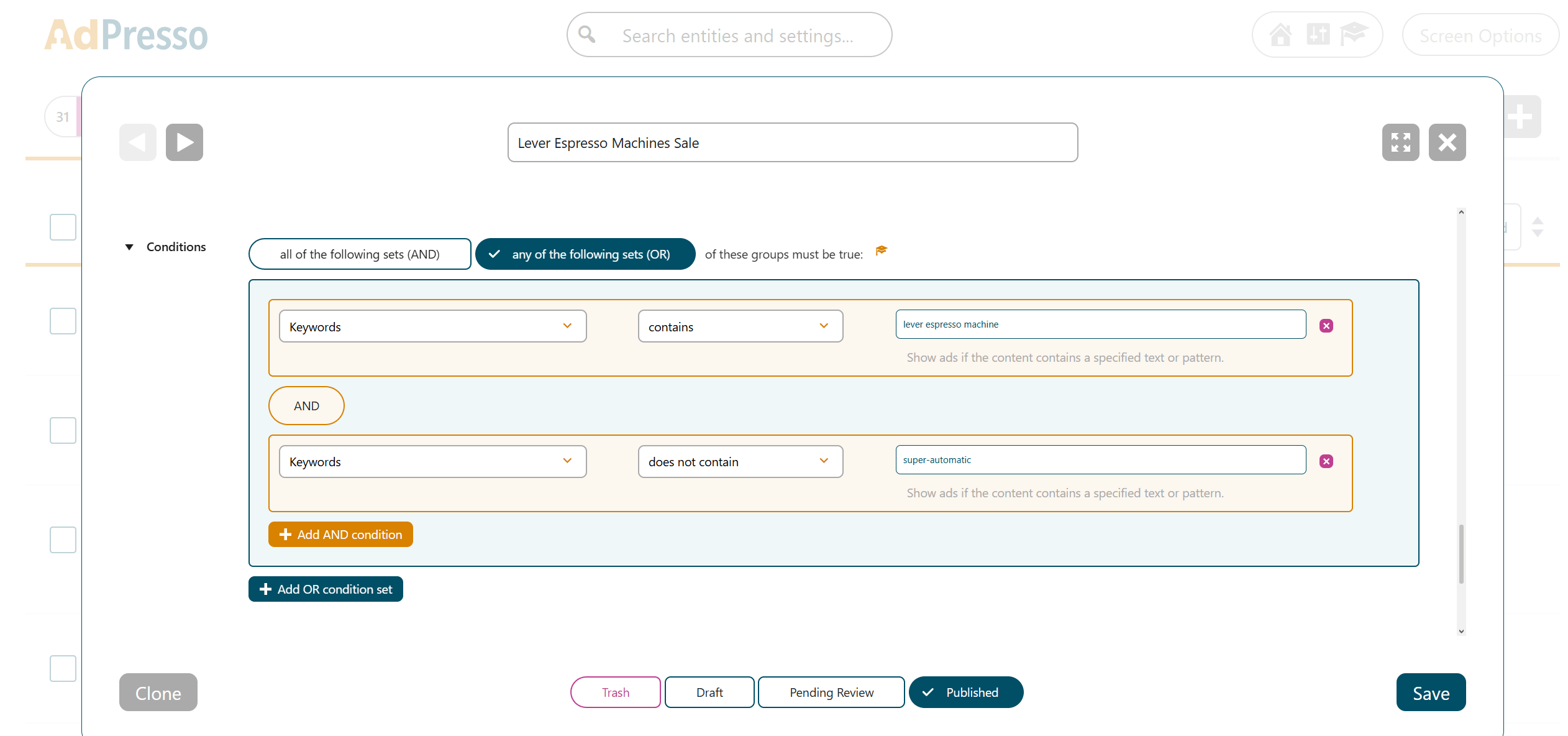
The important part is to think beyond individual keywords. A single word can occur in many contexts, so broader phrases are often more useful for product targeting. For example, “coffee” is too broad for an ad promoting a specific espresso machine, but “manual espresso machine” gives you a much clearer contextual signal.
Keywords are useful when the content itself provides the signal. But tags can be a better option when you already classify your articles in WordPress.
Suppose your website uses tags such as espresso machines, coffee grinders, and coffee beans. You can use these tags in AdPresso to determine which ads should appear on the corresponding content.
The editorial classification happens when you publish the article. Your advertising rules can then use the same classification without maintaining a separate keyword list.
It also makes the setup easier to maintain. If you regularly publish articles about the same product category, assigning the appropriate WordPress tag can become part of your normal publishing workflow.
Categories are useful when an entire section of your website should receive a particular type of advertising.
Imagine a website with categories for coffee machines, coffee accessories, and coffee recipes. You could assign different affiliate campaigns to each category and use AdPresso to display the corresponding ads.
The main advantage is scalability. When you publish a new article in a category, the advertising rule can apply to it automatically. You do not have to configure the new post separately.
Categories are therefore a good fit for broad contextual advertising in WordPress, while keywords are usually more useful when you need a more precise match.
Contextual targeting does not have to be completely automatic. Sometimes you need an exception.
An article may contain the right keyword but still be unsuitable for a particular affiliate campaign. Another page might cover several topics and create an ambiguous contextual signal. In these cases, AdPresso lets you use the Post / Page condition to control individual pages.
For example, you could target an affiliate campaign to articles containing “espresso machine” but exclude a specific article that discusses the history of espresso machines and has no commercial relevance.
Contextual advertising is particularly useful for affiliate publishers because the connection between editorial content and the advertised product can be very direct.
Consider a site publishing buying guides and product comparisons. An article titled “Best lever espresso machines for home use” already provides a strong contextual signal. An affiliate ad for a relevant espresso machine, grinder, or coffee accessory fits naturally into that environment.
The same principle applies across other niches.
| Content context | Suitable affiliate ad |
|---|---|
| Lever espresso machines | Espresso machines and accessories |
| Hiking trails | Hiking equipment and outdoor products |
| Running shoe reviews | Running shoes and running accessories |
| Home office setup | Desks, chairs, monitors, and office equipment |
| Camera buying guides | Cameras, lenses, and accessories |
For most WordPress publishers, a simple workflow is enough. Start by identifying your main content topics. Then decide which topics have a useful commercial connection. Create the relevant affiliate ads in AdPresso and assign conditions based on keywords, tags, or categories.
After that, review the pages where the ads appear. Check whether the context really matches the product and whether any pages should be excluded.
A useful setup might look like this:
Content topic → AdPresso condition → Affiliate ad → Ad Injection
Once the structure works, you can expand it to other topics without rebuilding the entire advertising setup.
A common mistake is to create too many individual rules. Contextual advertising becomes difficult to manage when every article has its own condition, and every small variation requires another ad.
Start with the content classifications you already use in WordPress. Use categories for broad topics, tags for established classifications, and keywords when you need a more specific content signal. Reserve individual page exclusions for genuine exceptions.
This approach keeps your contextual advertising setup close to your editorial structure. That matters for publishers because content changes continuously. A targeting system should follow those changes without requiring manual ad configuration for every new post.
With AdPresso, WordPress publishers can therefore implement contextual advertising using the structure they already have. Content determines what’s relevant, AdPresso applies the targeting conditions, and placements control where eligible ads appear.
