For years, online advertising relied heavily on third-party cookies. Advertisers could follow users across thousands of websites, build detailed profiles, and deliver highly personalized ads. That model is disappearing.
Privacy regulations such as the GDPR, browser restrictions, and growing user awareness have fundamentally changed how websites can collect and use data. Today, publishers need to understand where their data comes from, what they can legally use, and which advertising strategies still work without relying on invasive tracking.
Terms like first-party data, second-party data, and third-party data appear in almost every discussion about digital advertising. They sound technical, but the difference is simply who collected the data and who owns the relationship with the user.
Understanding these distinctions helps publishers make better decisions about advertising, analytics, consent management, and long-term monetization.
First-party data is information that you collect directly from visitors on your own website. Because your website has a direct relationship with the visitor, this is generally considered the most reliable and privacy-friendly type of data.
Examples include:
If someone visits your WordPress website, reads five articles about WordPress plugins, and signs up for your newsletter, that information becomes your first-party data. No external company collected it first, and no data broker is involved.
This direct relationship offers two major advantages.
For publishers, first-party data has become increasingly important because modern browsers continue to restrict third-party tracking technologies. Instead of depending on external advertising networks to understand your audience, you can build your own insights directly from user interactions on your website.
Second-party data is someone else’s first-party data shared through a direct partnership.
Imagine a travel website partnering with an airline. The airline has collected information from its own customers, while the travel website has its own audience. If both companies agree to share parts of their customer data, that information becomes second-party data for the receiving partner.
Unlike third-party data, both companies usually have a clear business relationship. Because the data originally comes from a trusted first-party source, it is often more accurate than information purchased from large data marketplaces.
Second-party data is most common among large businesses that operate complementary services. For most independent WordPress publishers, however, it plays only a minor role. Running a blog or content website rarely involves formal data-sharing partnerships, so most publishers rely on first-party data instead.
Third-party data is collected by companies that do not have a direct relationship with the people whose data they collect. Instead of gathering information from visitors to their own website, these companies aggregate data from many different sources, combine it into large audience profiles, and make those profiles available to advertisers.
Historically, this allowed advertisers to target users based on interests such as:
For many years, this formed the backbone of behavioral advertising across the web. Advertising platforms could recognize users across multiple websites through third-party cookies and build increasingly detailed profiles over time.
Today, that ecosystem is changing rapidly. Browsers such as Safari and Firefox already block most third-party cookies by default, while Chrome is steadily reducing their role. At the same time, privacy regulations require websites to obtain explicit user consent before many forms of cross-site tracking can take place.
Publishers can no longer assume that third-party data will always be available. Modern advertising strategies increasingly rely on first-party data, contextual advertising, and privacy-friendly tracking methods instead.
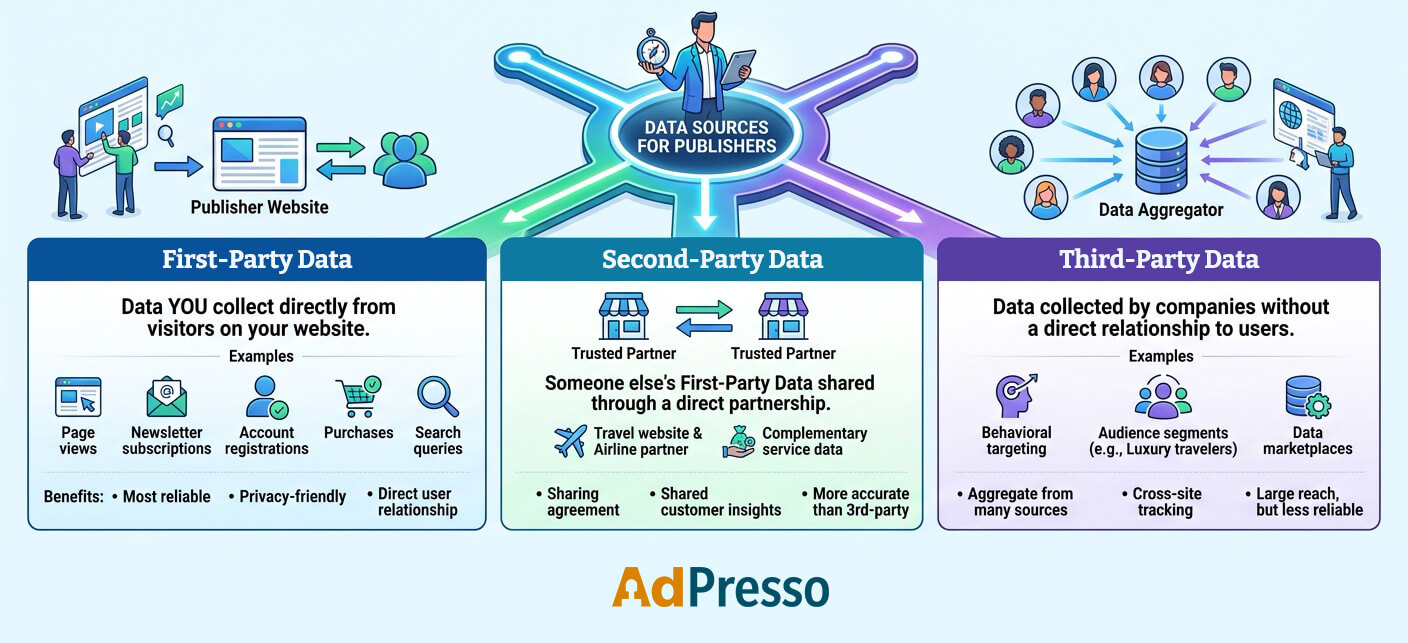
Understanding the different data types is useful, but the real question is how they affect your website.
Whether you run a niche blog, a news site, or a large publishing network, almost every advertising decision depends on data. Ad networks use it to select ads, analytics tools measure visitor behavior, and personalization features rely on it to improve engagement.
The challenge is that not every data source is equally available anymore. A visitor who accepts cookies may allow external advertising platforms to personalize ads. Another visitor may reject tracking completely. Some browsers block third-party cookies by default, while others limit how long cookies remain valid.
As a result, publishers can no longer rely entirely on third-party tracking to monetize their websites.
| Data Type | Typical Publisher Use | Future Outlook |
|---|---|---|
| First-party data | Analytics, subscriptions, user accounts, content personalization, direct advertising | Becoming increasingly important |
| Second-party data | Data-sharing partnerships between publishers or brands | Limited use for most publishers |
| Third-party data | Behavioral advertising, audience targeting, retargeting | Declining due to browser restrictions and privacy laws |
| Zero-party data | Surveys, preference centers, quizzes, user-selected interests | Growing as privacy-friendly personalization becomes more common |
For most WordPress publishers, the future revolves around first-party and contextual data rather than third-party tracking.
This is where many publishers experience an unexpected drop in ad revenue. When users decline consent through a cookie banner, advertising platforms may lose access to the data required for personalized advertising. Depending on your setup, this can affect several parts of your monetization stack:
Importantly, rejecting cookies does not necessarily prevent ads from being displayed. It mainly limits the user data available to select and measure those ads.
This is one of the most common questions among publishers, and the answer is slightly more nuanced than many articles suggest.
Your website itself generates first-party data whenever visitors interact with your content.
Google AdSense, however, is an external advertising platform. When AdSense processes user information for ad personalization, audience building, or cross-site advertising, it uses third-party technologies and therefore falls into the third-party ecosystem.
That doesn’t mean AdSense always relies on third-party data. Depending on the visitor’s consent, browser restrictions, and Google’s own Privacy Sandbox technologies, AdSense may instead serve:
In other words, AdSense is a third-party advertising service, but not every AdSense impression depends on third-party data.
The disappearance of third-party cookies does not mean publishers lose the ability to understand their audience. Instead, the focus shifts toward data that originates directly from the publisher’s own website.
Examples include:
Unlike third-party tracking, these insights remain under your control and are generally easier to combine with modern privacy requirements.
The shift away from third-party cookies doesn’t mean publishers have to accept lower ad revenue. It simply requires a different approach.
Instead of relying exclusively on external tracking, many publishers are moving toward a combination of first-party analytics, contextual advertising, and privacy-friendly monetization.
A modern advertising setup often includes:
The goal isn’t replacing every external ad network, but to reduce the dependence on such technologies that you can’t control.
AdPresso was built around the idea that publishers should stay in control of their advertising stack, even when visitors don’t consent to third-party tracking. Instead of relying entirely on external ad networks, AdPresso lets you combine different monetization strategies.
For example, you can continue serving Google AdSense or Google Ad Manager to visitors who grant consent while automatically displaying locally managed ads to visitors who reject tracking. This lets you keep advertising inventory filled without forcing every impression through a third-party advertising platform.
| Feature | Benefit for Publishers |
|---|---|
| Local ad management | Deliver banners, HTML ads, affiliate campaigns, or direct ads without external ad servers. |
| Privacy fallback ads | Automatically replace unavailable third-party ads with locally hosted alternatives. |
| Local impression and click tracking | Measure campaign performance without relying exclusively on external analytics platforms. |
| Contextual targeting | Display ads based on categories, tags, post types, authors, or custom conditions instead of user profiles. |
| Consent & TCF Integration | Fully integrated with privacy and consent management plugins and 100% support for the Transparency and Consent Framework (TCF) to ensure compliant ad delivery based on user choices. |
Rather than replacing existing ad networks, AdPresso complements them by giving publishers additional options whenever third-party advertising is unavailable or less effective.
Privacy-friendly advertising means building a monetization strategy that keeps working as privacy regulations change.
A few practical recommendations can make a significant difference:
Publishers who diversify their monetization strategy are generally better prepared for future changes in browser technology and privacy legislation.
They are related but not identical. A first-party cookie is a technical mechanism your website stores in the visitor’s browser. First-party data refers to information your business collects directly from users, whether it’s stored in cookies, a database, or another system.
Google AdSense is a third-party advertising service because Google processes advertising data on publishers’ behalf. However, not every AdSense impression relies on third-party data. Depending on consent, browser restrictions, and campaign settings, Google may serve contextual, non-personalized, limited, or personalized ads.
That depends on the analytics solution you use and the applicable privacy laws in your jurisdiction. Some privacy-focused analytics platforms can operate with minimal or no consent requirements under certain conditions, while others require explicit consent because they process personal data or transfer information to external providers. Always verify your implementation against GDPR or other applicable regulations.
No. First-party data simply describes where the information originates. It may contain anonymous statistics, pseudonymous identifiers, or personal information such as names and email addresses, depending on what your website collects.
Yes. As behavioral tracking becomes more restricted, many advertisers are investing more heavily in contextual targeting. Instead of analyzing individual users, contextual advertising focuses on the content of the current page, making it naturally more privacy-friendly while still delivering relevant advertisements.
Zero-party data is information users intentionally provide. Examples include survey responses, product preferences, interests selected in a profile, and quiz answers. Because users actively choose to share this information, zero-party data is often considered the most transparent form of customer data.