Ad refresh is a technique that allows publishers to swap out ads on their websites automatically. The goal is clear: to generate more ad impressions and, in turn, increase ad revenue. But be careful! Successful implementation requires a delicate touch. If you get it wrong, for example, with overly aggressive settings, both the user experience and ad performance will suffer.
In the following sections, I’ll show you why ad refresh can be an effective monetization strategy and which best practices you should follow to get the most out of it. I’ll also highlight the most common mistakes so you can avoid them from the get-go.
Ad refresh, sometimes also called auto-refresh ads, is a technique where ads displayed on a website are automatically replaced with new ones without the user reloading the page. The purpose is to increase the number of ad impressions per visit and thereby boost potential revenue.
The ads can refresh either at fixed time intervals or be triggered by specific, predefined user actions. Such triggers include clicks, scrolling, or other interactions. This way, your visitors see several different ads during their stay on a page without having to leave it.
For you as a publisher, this method can be desirable if your users spend a lot of time on your site, for example, reading long articles or watching videos. This approach allows you to generate additional impressions that you would lose without ad refresh.
However, there’s a catch: The CPM (Cost Per Mille) for refreshed ads is often lower than for the initial ones. An update that’s too quick or aggressive can also be disruptive. The effectiveness, therefore, depends heavily on how well you implement this technique and the structure of your visitors and content. But if you do it right, ad refresh offers a great way to use your ad space more efficiently.
There are various triggers for refreshing ads with ad refresh. A time-based trigger is the most common, but there are also user-action-based and event-based variants. The type you choose determines how often your ads are updated and how high the visibility for advertisers remains.
Here, an ad reloads after a fixed interval—usually 30, 60, or 90 seconds. Google Ad Exchange allows a minimum of 30 seconds but recommends 60. This method is easy to implement, but it carries the risk that ads will refresh even when users are not actively engaged, which can reduce visibility.
The update only happens after a specific action, such as scrolling or reaching the end of an article. Since users are active, visibility is usually higher. However, the ad might still be outside the visible area.
In this variant, a predefined event triggers the refresh, such as loading new content. Typical examples are updated sports scores or the completion of a game loading process. This method is less common but is excellent for dynamic content.
Unfortunately, not all ad networks allow the use of ad refresh. Some, like Google Ad Exchange, OpenX, and Rubicon, permit this technique under certain conditions. With Google AdSense, however, you need to be very careful: The policies state that pages or page elements may not be updated without an explicit user action.
This means that time-based updates are generally not permitted. However, an ad refresh might be allowed if it is clearly triggered by a user action—for example, when someone clicks on a slideshow. But if the slideshow runs automatically, that is considered an impermissible update.
Many publishers, therefore, prefer to avoid ad refresh with AdSense altogether to play it safe and instead rely on networks that permit this practice. When in doubt, always carefully read the terms and conditions of the respective partner program or ad network to avoid violations and possible sanctions.
Ad refresh can be beneficial for many websites, especially if the average session duration and time spent per page are high. It is suitable for service websites, gaming sites, blogs, online media, or sites with endless scrolling, among others.
However, the correct implementation is crucial. If ads reload in unsuitable positions, the risk of them not being seen increases. This behavior can significantly worsen the CPM, click-through rate, and visibility.
Whether an ad refresh actually increases your total revenue also depends on your monetization strategy. Programmatic advertising can help maximize revenue per user. If, on the other hand, you sell directly to advertisers, you should focus more on visibility and ad duration to secure the value of each placement. In these cases, a targeted optimization of the ad spaces is often more sensible than frequent updates.
Ad refresh can increase revenue, but on average, it leads to sinking CPMs the more often an ad is refreshed within a session. If you use the technique strategically in the right places, you can offset this effect with the higher total number of impressions.
Ad refresh can be an effective tool for maximizing your ad revenue, but you must implement it carefully. Here are the best practices for successful use.
Choose the refresh frequency so that it doesn’t negatively impact the user experience. Values between 30 and 60 seconds are often considered appropriate. For longer content, such as detailed articles, a slower interval might make sense, as your visitors spend more time reading. An interval that’s too short increases the number of impressions, but it can reduce visibility. It’s important to adjust the frequency to the content type, target audience, and placement. Large publishers often use different intervals to balance performance and user-friendliness.
An ad’s visibility determines its effectiveness. Ads should only update if at least 51% of their area is visible—80% is ideal. If the user is in another browser tab or more than half of the content is covered, no refresh should occur. Poor visibility can reduce the appeal to advertisers. Regular measurements help you detect problems early. Specially placed formats like sticky ads often achieve higher visibility values and are therefore more suitable for refreshing.
The optimal refresh rate depends on your content, placement, target audience, and inventory segments. That’s why you should first test different intervals on a small part of your website and compare the results with a control group. A proven strategy is to start with longer intervals (e.g., 90 seconds) and gradually shorten them. It’s also worth checking different placements, as particularly visible positions usually yield better results. Continuous adjustment is crucial to adapt to changing user habits and formats.
Before implementing ad refresh, check the guidelines of the ad network you are using. Not every network allows automatic updates, and there are often minimum intervals or restrictions for specific triggers. Some providers also require publishers to declare the use of ad refresh openly. If you violate the policies, you risk losing ad revenue or even getting suspended. Careful checking and adherence to these guidelines are therefore essential.
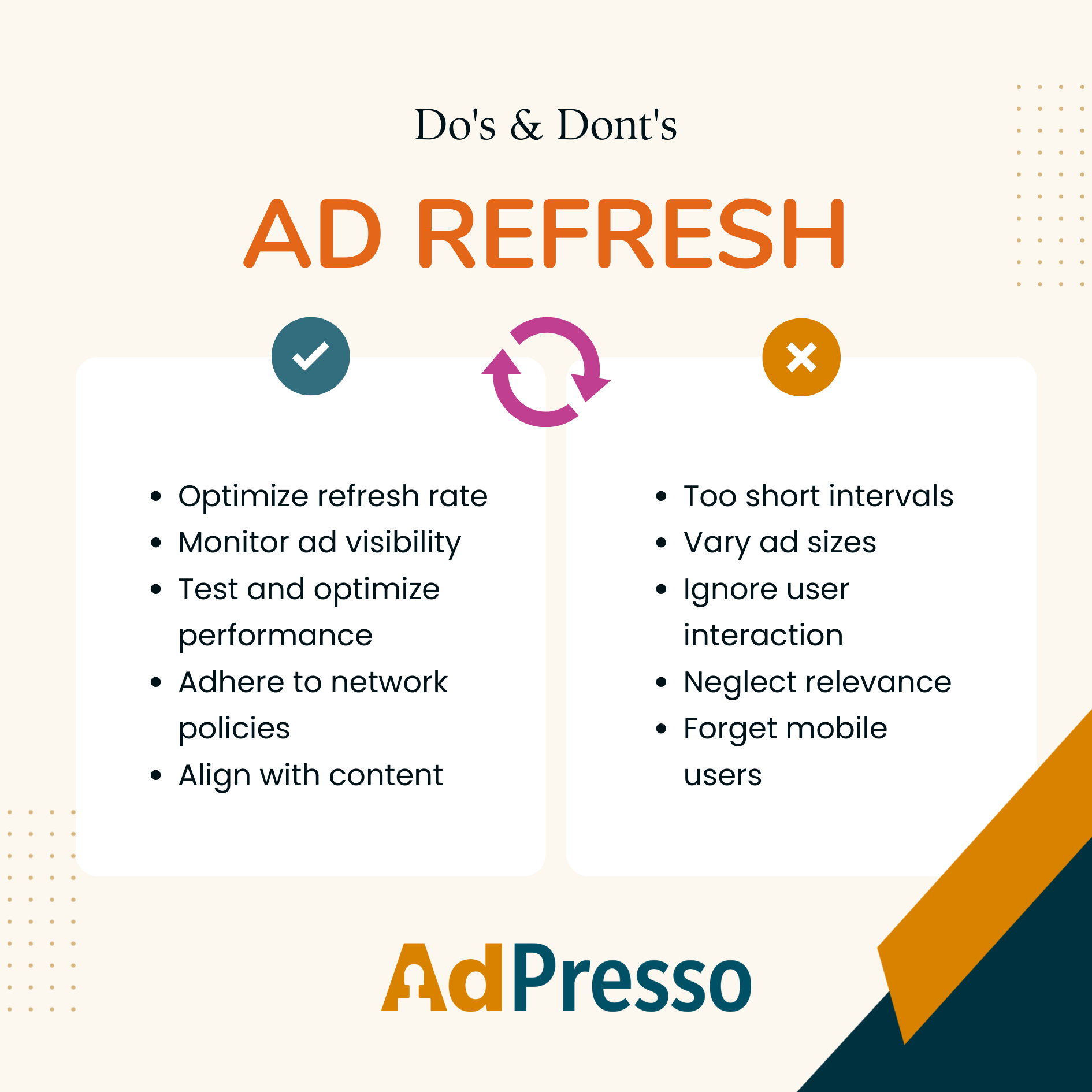
Beware of overly aggressive ad refresh settings and other pitfalls. Here are the most critical don’ts when using ad refresh.
Refreshing ads every ten seconds or even faster harms the user experience. Your visitors barely have time to notice the content or ads, which increases bounce rates and, in the long run, encourages the use of ad blockers. While impressions may rise with shorter intervals, CPMs often drop significantly. Every project has a unique “sweet spot” between impressions and revenue. To find it, A/B testing with different triggers and intervals is highly recommended.
Refreshing with varying ad sizes can cause layout shifts and lead to accidental clicks. Both negatively impact the user experience and can weaken trust in the website. You should load ads in the same size and position.
Ads should preferably update after genuine user activity—such as time on site, scrolling, or interactions with the ad area. If you ignore this, ads appear irrelevant and disruptive. This reduces the perceived value of the advertising, often lowers the click-through rate, and weakens visitor loyalty. Targeting interaction signals, on the other hand, increases relevance and value for advertisers.
A uniform approach for desktop and mobile ignores the special requirements of mobile usage. On smartphones, refreshing too frequently can increase data consumption, prolong loading times, and raise bounce rates. Mobile-optimized refresh strategies are crucial to prevent losing this growing target group.
When content and ads no longer match, the advertising loses its effect. A lack of thematic relevance can undermine trust in your website and ad partners, reduce user interest, and scare off advertisers in the long term. A continuous alignment between content and ads is therefore crucial for sustainable results.
A page’s initial loading time remains the same, regardless of whether ad refresh is activated. Only when the refresh trigger is activated does the browser send new HTTP requests to the ad server. This increases bandwidth consumption and can—depending on the user’s internet speed and location—impair loading speed and the user experience. This effect is more noticeable in regions with slow connections.
Before implementing ad refresh, check if it suits your content, target audiences, and target regions. A trade-off between potential additional revenue and possible losses in performance and user satisfaction is crucial. It’s also important not to confuse an ad refresh with a full page reload. The latter leads to constant reloads, high bounce rates, and a poor user experience, and you should avoid that at all costs.
Ad refresh can significantly improve monetization if used strategically. The key is to find the right balance between the frequency of ad updates and user-friendliness. Publishers should follow clear rules for implementation, regularly monitor ad performance, and keep an eye on the potential effects on the user experience. Mistakes like refreshing too often or thoughtless placement can diminish revenue and annoy users.
With a structured approach, you can effectively refresh and integrate it into your existing ad delivery, which can sustainably optimize both impressions and ad revenue.