The need for clear separation between editorial and commercial content has become non-negotiable in modern digital publishing. Proper disclosure protects your audience from misleading impressions and shields you as a publisher from costly penalties. At the center of this responsibility is the ad label, also known as an ad badge or commercial disclosure.
This guide takes you through every aspect that matters to publishers, including legal requirements, placement rules, design standards, and the distinction between ad labels and affiliate disclosures so that you can maintain full compliance across your inventory.
An ad label is a required, visible marker that clarifies the commercial nature of digital content or placements. Its primary role is to satisfy the legal obligation to separate editorial and paid material. It immediately signals to the user that they are looking at paid or otherwise commercially influenced communication and not at editorial content.
The obligation applies to all forms of advertising. That includes classic display ads, native formats, sponsored pieces, and product placements in audio or video. To comply with national and international rules such as the German MStV or the FTC’s Endorsement Guides, the label must always be prominent and hard to miss. It must appear directly next to the advertising content and cannot be placed behind clicks, in footers, or in dropdowns.
Precise local-language terms, such as “Advertisement,” are essential to prevent confusion. The label must also be readable at a glance and offer enough contrast to stand out from its background. Only when these conditions are met does the label provide both its consumer protection function and a stable legal foundation for publishers who need to build long-term trust.
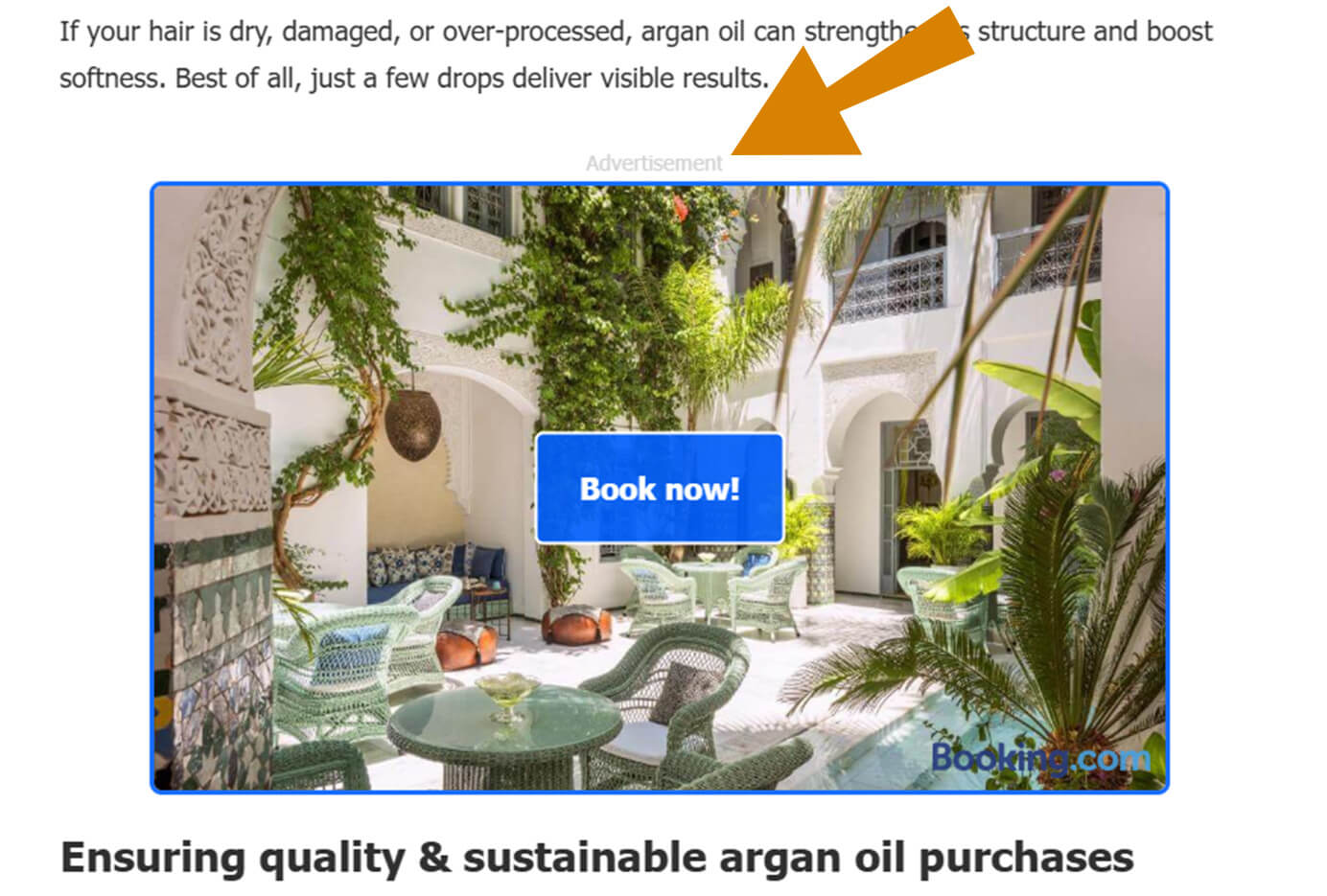
Ad badges disclose paid advertising, such as display ads, sponsored articles, or native formats. Affiliate disclosures perform a different job. They explain that a piece of content contains affiliate links and that the publisher may receive compensation for qualifying purchases. Both increase transparency, but they describe entirely different commercial relationships: ad labels cover direct advertising deals, and affiliate disclosures cover commission-based partnerships.
There is no universal global standard for ad labels. Each country applies its own legal framework and self-regulatory codes that define how advertising must be disclosed. For publishers operating across borders, this means transparency is universally required, but its implementation varies by market, language, and placement rules.
In the United States, the FTC’s Endorsement Guides require clear, unavoidable disclosure of material connections and advertising. In Germany, the Media State Treaty (MStV) and accompanying guidelines from regulatory bodies define the basic rules; additional EU-level regulations apply to political advertising. France, Italy, and Spain rely heavily on self-regulatory bodies that recommend specific terms and placements in each local language.
| Region / Area | Main regulatory / self-regulation frameworks | Obligation to label ads on websites? |
|---|---|---|
| USA | FTC Endorsement Guides (16 CFR Part 255) | Advertising content must be clearly and visibly disclosed. |
| EU (political advertising) | Regulation (EU) 2024/900 (and implementing Regulation 2025/1410) | For political ads, yes. For general advertising, labelling obligations vary by member state. |
| Germany | Medienstaatsvertrag (MStV) § 22, § 74 in conjunction with § 8 Abs. 3; plus guidelines by national media authorities | Advertising must be clearly recognizable as such on websites. |
| France | ARPP Digital Advertising & Marketing Communications Code (and broader French ad law) | Commercial content must be clearly disclosed on websites. |
| Italy | IAP Digital Chart (Digital Chart regulations for online advertising) | Clear labelling of commercial messages on the web is mandatory. |
| Spain | AUTOCONTROL Code of Conduct (incl. Code for influencer advertising) | Clear disclosure of commercial content is required on websites and social media. |
Ad labels protect you from heavy penalties and reputational damage while strengthening long-term trust with your users. But the clearer you label an ad, the easier it is for users to identify and ignore it, which may reduce click-through rates. This creates the well-known tension between compliance and monetization.
The goal for publishers is to position the commercial disclosure boldly enough to satisfy regulators while keeping administrative overhead and CTR losses under control. Over time, the credibility gained from transparency usually outweighs any short-term decrease in engagement.
| Pro | Contra | |
|---|---|---|
| Legal Risk | Avoids high fines and legal disputes through proper compliance. | Additional administrative effort is required to implement the rules correctly across multiple platforms. |
| User Interaction | Builds trust and transparency; helps protect your reputation. | Potential decrease in CTR and overall ad performance. |
Ad labels are non-negotiable for protecting your business and maintaining user trust, even though they may reduce CTR in the short term. Start by understanding your local legal requirements. To simplify implementation, use an ad management plugin like Adpresso, which handles most of the operational work. The label must always be placed directly above the ad and be instantly visible across devices. Use precise terms like “advertisement” or “sponsored”. For video content, the disclosure must appear inside the video itself.
Commercial disclosures must be clear, prominent, and placed close to the advertising unit to satisfy both FTC and MStV standards. This applies to display ads, sponsored content, affiliate links, and native integrations across all devices. You should position ad labels above, below, or next to the advertising element. Never hide them at the end of the page or behind user interaction.
| Design criteria | Requirements | Examples/Tips |
|---|---|---|
| Font size & contrast | Readable, high contrast with background; do not minimize Minimum 12‑14px, dark text on a light background; FTC test: clearly legible from 1 meter distance | Readable, high contrast with background; do not minimize Minimum 12‑14px, dark text on a light background; FTC test: clearly legible from 1 meter distance |
| Color & highlighting | Stand out from content (bold, border, background color) Yellow or white background with black text; avoid footer placement | Stand out from content (bold, border, background color) Yellow or white background with black text; avoid footer placement |
| Format/language | Clear terms (e.g., "Ad", "Sponsored"); appropriate for the medium | For audio: sufficient volume; for images: overlay text visibly |
The goal is a clean and user-friendly integration that remains compliant without blocking content. Tools like the AdPresso plugin help automate correct placement. Violations often lead to fines since misleading presentation is a key compliance trigger.
Strict compliance with separation rules requires using the most direct equivalents of “Advertisement”. Terms like “sponsored” describe the type of cooperation but do not necessarily clearly identify advertising. To meet global expectations for clarity, stick to full, unambiguous wording.
| Language | Option 1 | Option 2 |
|---|---|---|
| AR (Arabic) | إعلان (I'lan) | محتوى دعائي (Muḥtawa Da'ā'ī) |
| CN (Chinese) | 广告 (Guǎnggào) | 推广 (Tuīguǎng) |
| DE (German) | Werbung | Anzeige |
| EN (English) | Ad | Advertisement |
| ES (Spanish) | Publicidad | Anuncio |
| FR (French) | Publicité | Annonce |
| ITA (Italian) | Pubblicità | Annuncio |
| JP (Japanese) | 広告 (Kōkoku) | プロモーション (Promotion) |
| KR (Korean) | 광고 (Gwang-go) | 광고성 메시지 (Gwanggoseong Meseji) |
| NL (Dutch) | Advertentie | Reclame |
| PL (Polish) | Reklama | Ogłoszenie |
| PT (Portuguese) | Anúncio | Publicidade |
| RU (Russian) | Реклама (Reklama) | Объявление (Ob'yavleniye) |
| SE (Swedish) | Annons | Reklam |
| TR (Turkish) | Reklam | İlan |
Managing individual ad badges manually inside WordPress becomes inefficient and risky once you operate multiple placements. Errors accumulate quickly and can lead to compliance issues. A dedicated plugin is therefore essential.
For WordPress publishers, the free Adpresso plugin provides a centralized, automated way to manage commercial disclosures. You activate the label module globally, define a default term like “advertisement,” and allow specific labels to override global ones where needed. This ensures consistent compliance with minimal administrative effort.
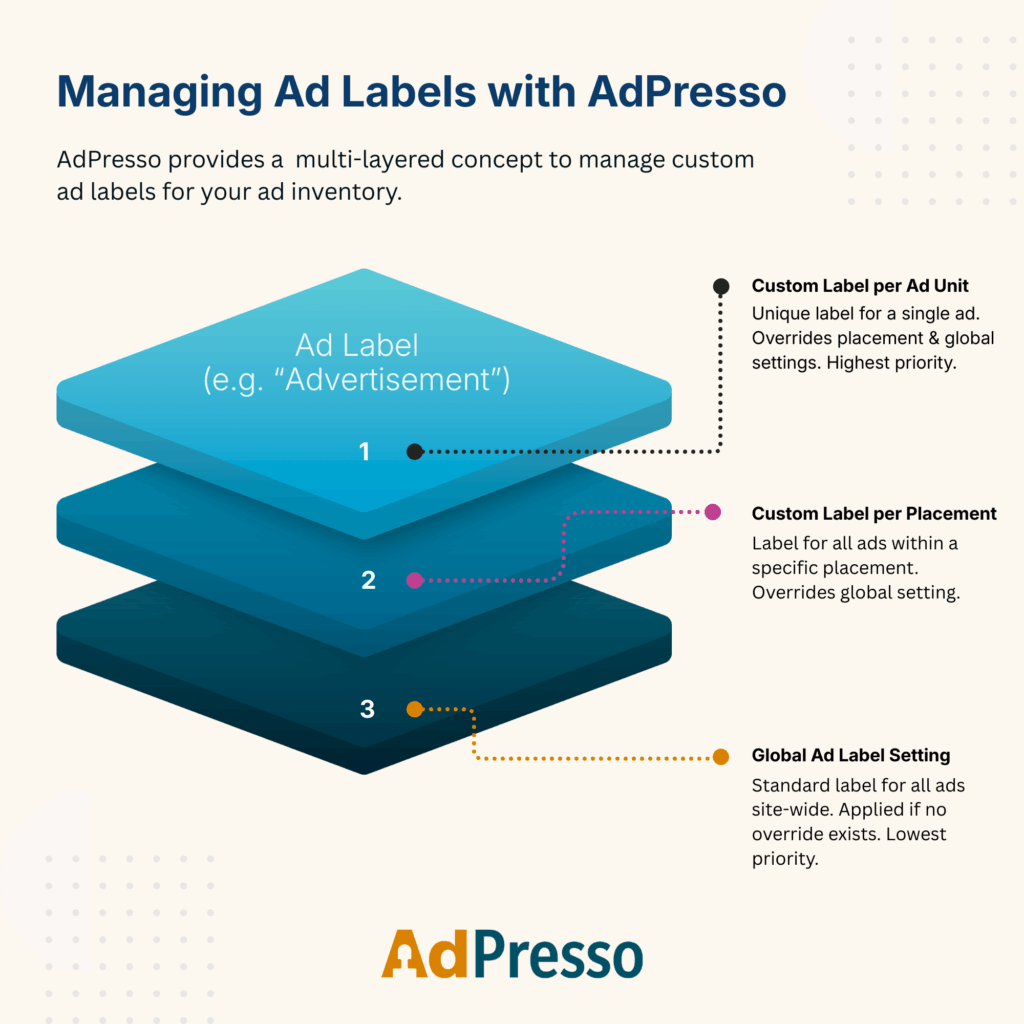
For styling options such as soft gray backgrounds or vertical alignment, refer to the dedicated ad label manual.
Following advertising disclosure rules has become an unavoidable foundation for digital publishers. Regulatory developments, such as the DSA and increased national oversight, continue to raise the operational bar.
Strict transparency standards also make your inventory safer and more attractive for premium advertisers. Given the high expectations for clarity and placement, an automated, centralized solution like AdPresso is one of the most efficient ways to maintain compliance, reduce legal exposure, and keep your ad performance stable in a complex, evolving market
